
Prefab vs Conventional Construction: A Side-by-Side Comparison (2026)
Updated: Aug 26
Prefab vs Conventional Construction: A Side-by-Side Comparison (2026)

Having examined prefab's advantages and limitations separately, this article puts prefab and conventional construction directly side by side, factor by factor, across the eight criteria that actually determine which approach fits a specific project. No single winner emerges across every row - and that is precisely the honest, useful answer.
In This Guide You'll Learn
✔ Construction time compared directly, with the mechanism behind the gap
✔ Quality control differences between factory and site-based construction
✔ Labour dependency and skilled-trade availability across both methods
✔ Durability and long-term maintenance demands of each approach
✔ Scalability for multi-unit projects like resorts and developments
✔ Lifecycle cost - the comparison that actually matters most
Introduction
Conventional construction and prefab construction are not simply two different processes arriving at the same result - they differ in fundamental ways across nearly every dimension that matters to a buyer or developer: how long the project takes, how consistent the resulting quality is, how dependent the project is on local skilled labour, how sustainably it uses materials, how the finished building ages, how easily it scales across multiple units, and what it actually costs across its full lifecycle rather than just on handover day.
This article compares both methods across all eight factors, drawing on the detail already covered across this pillar's earlier stages and articles, so you can weigh the comparison against your specific project's actual priorities rather than a generic recommendation.
1. Construction Time
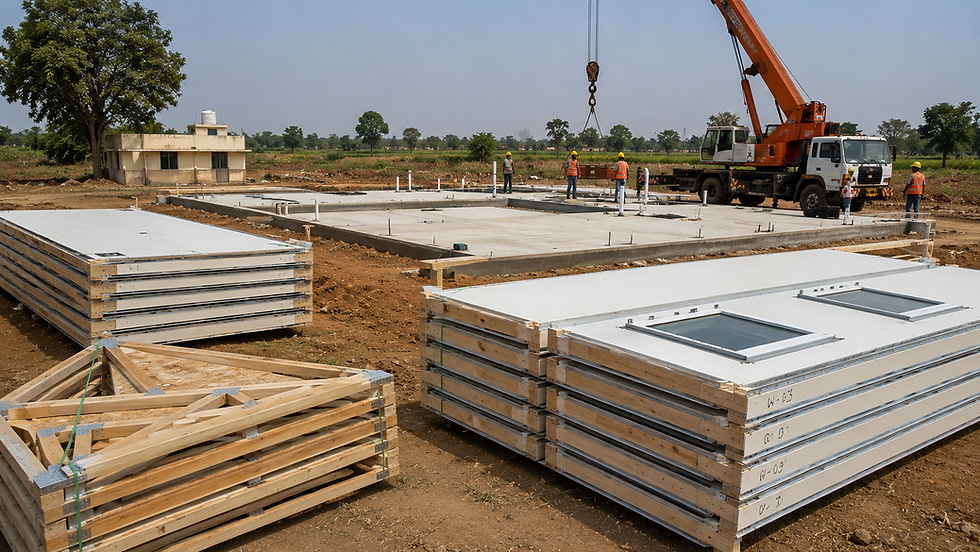
Conventional construction proceeds sequentially on-site - foundation, structure, walls, finishes - with each stage vulnerable to weather delays, typically extending a residential project to eight months or considerably longer. Prefab construction manufactures the building in parallel with site foundation work, delivering complete homes in 45 to 90 days, a timeline gap measured in months rather than weeks.
2. Quality Control
Conventional construction quality depends substantially on individual site worker skill and supervision on any given day, weather conditions during critical work, and the difficulty of correcting concealed defects once work has progressed past them. Prefab manufacturing, covered in depth across Stages 1 through 3 of this pillar, applies jig-verified tolerances, documented quality gates at every station, and controlled indoor conditions that remove weather as a quality variable entirely.
3. Labour Dependency
Conventional construction depends heavily on the availability of skilled masons, carpenters and site supervisors in the specific project location, with quality and timeline both vulnerable to local labour shortages or turnover during a long build. Prefab construction concentrates skilled trades inside a fixed factory workforce whose expertise compounds across hundreds of projects, with site-level labour needs reduced to installation crews rather than a full construction workforce - a meaningful advantage for remote sites where sourcing skilled conventional labour locally is genuinely difficult.
4. Sustainability and Material Efficiency
Conventional on-site construction typically generates more material waste through imprecise cutting and weather-related material damage, and depends heavily on cement production, a significant contributor to construction-sector carbon emissions. Prefab manufacturing, driven by precise digital cutting and protected from weather exposure during production, achieves measurably better material efficiency - a theme this pillar's Stage 5 on sustainability explores in considerably more depth.
5. Durability and Long-Term Maintenance
Conventional Construction's Durability Profile
RCC construction, correctly built, offers proven long-term durability but carries a specific vulnerability to reinforcement corrosion over decades, requiring periodic inspection and eventual remedial work on ageing structures - a well-documented failure mode in Indian conventional construction.
Prefab's Durability Profile
LGSF prefab construction, protected by correctly specified galvanised coating as covered in this pillar's Stage 3, avoids the corrosion vulnerability entirely and requires minimal ongoing structural maintenance across its 50-year design life, backed by Loom Crafts' 20-year structural warranty.
6. Scalability for Multi-Unit Projects
Conventional construction scales linearly - building ten resort cottages conventionally takes roughly ten times the site labour and sequential time of building one, with quality consistency across units depending on maintaining the same site crew and supervision throughout. Prefab manufacturing scales far more efficiently for multi-unit projects: the factory can produce multiple identical or varied units in parallel, delivering consistent quality across every unit regardless of how many are ordered, which is precisely why prefab has grown fastest in India's resort and boutique hospitality development sector, covered further in this pillar's Stage 6.
💡 Loom Crafts Expert Insight — A hospitality developer building a twelve-cottage boutique resort near Alibaug specifically chose prefab after realising that a conventional build would need to either extend the timeline considerably to maintain quality consistency across all twelve units with a single crew, or risk visible quality variation between early and late cottages if multiple crews worked in parallel. Our factory line delivered all twelve to the same jig-verified specification simultaneously - a scalability advantage that matters more with every additional unit a project requires.
7. Lifecycle Cost: The Comparison That Actually Matters
Comparing only headline construction-day pricing misleads more than it informs. Conventional construction's often-lower initial quotation must be weighed against the value of months of additional time, financing carry cost across that longer period, and eventual corrosion-related repair costs. Prefab's higher-appearing upfront material cost is offset by dramatically reduced timeline - meaning earlier occupancy or, for hospitality projects, earlier revenue generation - plus minimal ongoing structural maintenance across a fifty-year design life. The full lifecycle comparison, not the construction-day number alone, is the one that should actually drive the decision.
Design Approval and Iteration Speed Compared
A further comparison worth adding concerns how efficiently each method handles design development and approval before construction begins. Conventional construction, with its greater on-site flexibility for late changes as this pillar's myths article noted, can sometimes tolerate a less thoroughly finalised design before groundbreaking, with adjustments made incrementally as work proceeds. Prefab construction's design-freeze requirement, covered throughout this pillar, demands more thorough upfront design iteration and client sign-off before manufacturing begins, which can feel like a slower start to some clients even though it ultimately produces a faster overall project timeline once manufacturing and site preparation begin their parallel progress.
This distinction is worth understanding clearly: prefab's speed advantage applies specifically to the construction phase after design freeze, not necessarily to the design development phase itself, which benefits from the same thoroughness regardless of construction method, but which prefab's locked-file manufacturing process makes considerably more consequential to get right before proceeding.
Insurance and Risk Profile Compared
Construction insurance considerations differ somewhat between the two methods, worth understanding as part of a complete comparison. Conventional construction's extended, open-site timeline carries prolonged exposure to weather damage, theft of materials left on an accessible site, and general site liability risk across many months, while prefab construction's compressed on-site installation period, following weather-protected factory manufacturing as this pillar's manufacturing articles described, meaningfully reduces the duration of on-site risk exposure, potentially affecting both insurance cost and the practical risk a client and their insurer face across the project's duration.
How This Affects Practical Risk Management
A conventional construction site accumulating valuable materials over many months presents a genuinely longer window for theft or weather damage than a prefab site, which receives most of its value in concentrated, scheduled deliveries close to actual installation rather than stockpiled materials sitting exposed across an extended timeline - a practical risk management advantage worth factoring into any complete method comparison, alongside the more commonly discussed timeline and cost factors this article has already covered in detail.
💡 Loom Crafts Expert Insight — A developer once mentioned that their insurance broker specifically noted our compressed on-site timeline as a factor in offering more favourable construction insurance terms compared to a conventional build of similar value, precisely because the total window of on-site risk exposure was considerably shorter. It's not a factor most clients think to ask about, but it's a genuine, quantifiable difference between the two construction approaches worth raising with your own insurer during project planning.
Workforce Wellbeing Compared Across Both Methods
A dimension of this comparison rarely discussed but genuinely meaningful concerns the working conditions each method offers the people actually doing the building. Conventional construction site labour, particularly in India's climate extremes, involves considerable outdoor exposure to heat, monsoon rain and dust across an extended project timeline, work that carries genuine physical strain regardless of how skilled or careful the workforce is. Factory-based prefab manufacturing, by contrast, offers workers a controlled indoor environment with consistent conditions year-round, and the shorter on-site installation period this pillar has described throughout means even the site-based portion of prefab construction work involves considerably less prolonged outdoor exposure than an equivalent conventional project's many months of site-based labour.
💡 Loom Crafts Expert Insight — This isn't a factor most clients consider when comparing construction methods, but it matters to us directly as an employer - our factory workforce operates in a controlled environment year-round, a genuinely different working experience than the outdoor conditions our installation crews' conventional-construction counterparts face across an extended eight-month site timeline. It's not the primary reason clients choose prefab, but it's a real, positive difference worth acknowledging as part of this pillar's honest, complete comparison between the two methods.
8. Three Worked Scenarios: Which Method Wins, and Why
Comparisons become useful when applied to real situations, so consider three common Indian scenarios. Scenario one: a weekend farmhouse two hours from the city. The owner visits fortnightly at best — which makes conventional construction's greatest hidden cost, supervision, unpayable. Quality drifts precisely when nobody is watching. Prefab wins decisively here, because the quality-critical work happens in a supervised factory and the site phase is short enough to attend personally. Scenario two: a city home on a tight infill plot with the family living next door. Both methods can deliver, but the decision often turns on disruption: months of material stacking, labour presence, noise and dust against a few weeks of managed installation. Scenario three: a large custom residence with heavy masonry aesthetics, stone arches and cast-in-place sculptural elements. Here conventional methods — or a hybrid — may genuinely serve better, because the design intent is intrinsically wet-built. The honest conclusion this article stands behind: the method should follow the project, and knowing when each wins is exactly the literacy this comparison exists to build.
9. The Hybrid Reality: How the Methods Increasingly Work Together
The framing of 'prefab versus conventional' can obscure how often the methods now cooperate on a single project. Every prefab building already stands on conventionally cast foundations; many pair a factory-built main structure with site-built compound walls, landscape masonry and water features; resorts routinely combine prefab guest cottages with a conventionally built central block housing kitchens and back-of-house services. Developers increasingly choose per component: factory precision where the envelope and finish quality live, conventional flexibility where in-ground and sculptural work demands it.
Foundations and site works — always conventional, always local, and best contracted with the prefab installation calendar in writing.
The building envelope — the strongest case for the factory: insulation, membranes and tolerances repeat perfectly indoors.
Compound and landscape elements — natural territory for local masonry trades, sequenced after installation so the site stays clear for cranes and delivery.
Interiors — factory-fitted for speed and consistency, or site-fitted where bespoke carpentry is the point; both routes are routine.
Seen this way, the comparison matures from rivalry into allocation: put each rupee of construction where its method performs best, and let the project — not tribal loyalty to a technique — collect the benefit.
Frequently Asked Questions (FAQs)
1. Is prefab construction always faster than conventional construction?
Yes, meaningfully so - typically 45 to 90 days against 8 months or more, because manufacturing proceeds in parallel with site foundation work rather than sequentially after it.
2. Is prefab construction better quality than conventional construction?
Prefab offers more consistent quality due to factory-controlled conditions and jig-verified tolerances; conventional construction's quality depends more heavily on individual site workmanship and supervision.
3. Does prefab construction reduce dependency on local skilled labour?
Yes - skilled trades are concentrated in the factory workforce, reducing on-site labour needs to installation crews, which particularly benefits remote sites with limited local skilled labour.
4. Which is more sustainable: prefab or conventional construction?
Prefab manufacturing generally achieves better material efficiency and less waste due to precise digital cutting and weather-protected production conditions.
5. Does prefab construction scale better for multi-unit projects like resorts?
Yes - factory production can deliver multiple units in parallel with consistent quality, a significant advantage for boutique resorts and multi-cottage developments compared with sequential on-site building.
6. Which construction method has lower lifecycle cost?
It depends on the project, but prefab's reduced timeline, lower ongoing maintenance and avoidance of corrosion-related repairs often result in favourable lifecycle cost despite a sometimes higher headline construction price.
Conclusion
Prefab and conventional construction are not simply faster versus slower, or better versus worse - they differ meaningfully across time, quality consistency, labour dependency, sustainability, durability, scalability and true lifecycle cost, and the right choice depends on which of those factors matter most for your specific project. For the large majority of Indian residential, farmhouse and boutique hospitality projects, prefab's advantages across most of these eight factors explain why it has grown from alternative method to default choice - but the honest comparison, not a blanket claim, is what should inform your decision.
📌 Add Loom Crafts Prefab as a Preferred Source on Google to see more of our guides in Top Stories and AI search.
Continue Reading
Continue Your Stage 4 Journey
Popular Answers and Deep Dives
Ready to Build Your Dream Home?
Loom Crafts Prefab outperforms conventional construction across time, quality consistency and lifecycle cost - backed by a track record across hundreds of Indian projects. We support home builders with:
A direct lifecycle cost comparison against conventional construction for your project
45 to 90 day delivery with fixed, itemised pricing
Consistent, jig-verified quality across single homes and multi-unit developments alike
A 20-year structural and rain-leakage warranty
Proven scalability for resort and hospitality projects requiring multiple units
Call Us: +91 84484 40556 | Email: info@loomcrafts.com
📅 Prefer a live walkthrough? Book a free online demo at a time that suits you — our team will take you through designs, 2026 pricing and the complete build process on a video call: Book Your Online Demo
Important Disclaimer
This article is provided for general educational purposes only. Comparisons, figures and construction practices described are indicative, vary by manufacturer, project, location and market conditions, and change without notice. This content does not constitute engineering or financial advice. Always obtain project-specific quotations and consult qualified professionals before making construction decisions.


Comments