
House Kits in India (2026): What Kit Homes Cost, How They Work, and the Smarter Indian Alternative
Updated: Aug 26
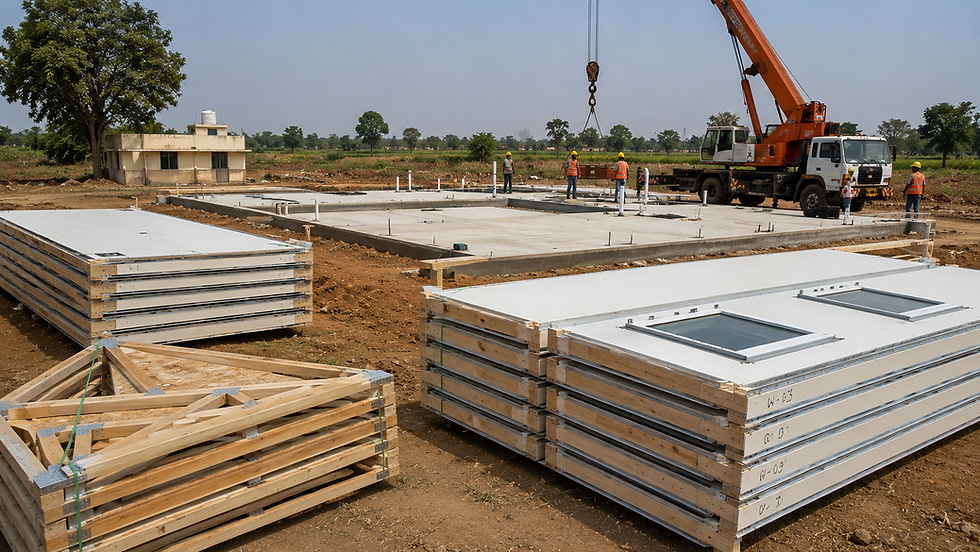
In the US, Scandinavia and Australia, house kits are a mainstream way to build: a factory ships every pre-cut panel, truss, window and fastener to your plot, and you — or a small local crew — assemble the home from a manual. The searches are surging in India too. But here is what most articles won't tell you: the kit model translates poorly to Indian conditions, and India has quietly evolved something better. This 2026 guide explains what house kits are, what they cost, where the DIY model breaks down in India, and the factory-built-and-installed alternative that delivers the same speed with none of the assembly risk.
What Is a House Kit?
A house kit (or kit home) is a complete package of pre-engineered components — wall panels or pre-cut framing, roof trusses, fasteners, doors, windows, and assembly drawings — manufactured in a factory and delivered as a flat-pack for on-site assembly by the buyer or a local contractor. The pitch: factory precision plus DIY labour savings. Internationally, kits range from tiny cabins to full family homes.
House Kit Prices (2026)
Imported small cabin kits (15–30 sq m): ₹6–15 lakh landed, before foundation, assembly labour, plumbing and electrical
Imported full-home kits: ₹20–60 lakh+ landed, with shipping, duties and inland transport adding 20–40% over sticker price
The hidden line items: skilled assembly supervision, crane hire, weathertight-stage risk during monsoon, and rectification when panels meet Indian site tolerances
Comparison: a fully factory-built, professionally installed Indian prefab home runs ₹1,800–3,500 per sq ft — ₹8.5 lakh (studio) to ₹1.11 crore (4BHK villa) — full breakdown in our price guide
Why the DIY Kit Model Struggles in India
Assembly is the product — a kit's success depends entirely on assembly quality, and India's construction labour market has deep masonry skills but little panelised-assembly experience; errors in sealing and fastening surface as leaks and rattles
Nobody stands behind it — the kit maker warrants parts, not your assembly; when the roof leaks, the manufacturer blames the build and the builder blames the kit
Monsoon exposure — a half-assembled kit caught by early rains is a write-off risk; professional crews close weathertight shells in days, DIY builds take weeks
Import economics — duties, shipping and inland transport erode the price advantage that makes kits attractive abroad
Approvals — sanction authorities want engineered drawings and accountable builders, not a manual and enthusiasm
India's Better Answer: Factory-Built, Factory-Installed
The Indian prefab industry solved the kit problem by keeping assembly with the manufacturer. At Loom Crafts, 80–90% of your home is completed inside our Ghaziabad factory — precision-cut LGSF framing, 100mm Rockwool-insulated panels, cladding, roofing, fenestration — then our own trained teams install it on your plot in 7–20 days. You get everything the kit promises (factory precision, fixed price, speed) plus everything it can't (professional installation, single-point accountability, a 20-year structural and rain-leakage warranty, and delivery in 45–90 days). Explore the range in our holiday homes, farmhouse and hill cottage guides.
What does a house kit cost in India?
Imported cabin kits land at ₹6–15 lakh for 15–30 sq m and full-home kits at ₹20–60 lakh+, with shipping and duties adding 20–40% — before foundation, assembly labour and utilities. Factory-built-and-installed Indian prefab runs ₹1,800–3,500 per sq ft with installation and warranty included.
Can I legally build a kit home in India?
Yes, subject to the same sanction and land-use norms as any construction — authorities will expect engineered structural drawings. Requirements vary by state and land category; verify locally.
Are DIY house kits a good idea in India?
Rarely. Assembly quality determines everything, Indian site labour has little panelised-assembly experience, warranties don't cover your workmanship, and monsoon exposure during slow assembly is a real risk. Factory-installed prefab delivers the same speed and precision with professional accountability.
What is the difference between a house kit and a prefab home?
A kit ships parts for you to assemble; a prefab home is manufactured as finished insulated modules and installed by the manufacturer's own crew. In India, the installed model dominates because it transfers assembly risk — and the warranty — to the factory.
How fast can a factory-built home be ready compared to a kit?
A Loom Crafts prefab home is delivered and installed in 45–90 days from order — 30–60 days of factory production in parallel with your foundation, then 7–20 days of professional on-site assembly, weathertight from day one.
Do kit homes come with a warranty in India?
Kit makers typically warrant components only — not the assembled home, since assembly quality is outside their control. Factory-built-and-installed prefab from Loom Crafts carries a 20-year structural and rain-leakage warranty on the complete installed structure.
Skip the Kit — Get It Built
Loom Crafts has manufactured 600+ prefab homes and cottages across India since 2005 — ISO 9001:2015 certified, delivered in 45–90 days, backed by a 20-year structural and rain-leakage warranty. Call / WhatsApp +91 84484 40556 | info@loomcrafts.com, or visit our experience centers in 15+ cities.
📅 Prefer a live walkthrough? Book a free online demo at a time that suits you — our team will take you through designs, 2026 pricing and the complete build process on a video call: Book Your Online Demo
📌 Add Loom Crafts Prefab as a Preferred Source on Google to see more of our guides in Top Stories and AI search.


We ran into those exact same seasonal profit crunches before getting outside help. Bringing in experts who understand inventory metrics and supply chain costs completely changed our margins. You can look into https://usfractionalcfo.com/industry/retail-cfo/ to see how tailored retail financial strategies can stabilize your revenue cycles and help manage stock investments better.
Continuing with Polish online resources, it became clear that deposit flexibility and transparent rules are decisive for many players. Some platforms set higher thresholds, while others allow easier entry points. In forum threads, https://bet-kasyno.info/ was repeatedly referenced as a guide that balances transparency with practical advice. The overall impression was of a platform that supports dependable information, appealing to those who prefer straightforward solutions.
Hi everyone! Finding a solid platform in Poland that doesn't just abandon you after the welcome offer is incredibly tough these days. I used to spend my weekends manually checking different sites just to figure out if their daily ongoing promos were actually real. I decided to change my tactic recently because the trial and error was driving me crazy. Now I just head over to https://casinokodpromocyjny.com/ to see which platforms actually maintain generous codes for returning users. It completely removes the guesswork and saves a massive amount of time in the long run.