
Steel vs Timber vs RCC: Choosing the Right Structural System (2026)
Updated: Aug 26
Steel vs Timber vs RCC: Choosing the Right Structural System (2026)

Every building conversation eventually arrives at this question, usually phrased less precisely: "why steel, and not just normal construction?" It deserves a proper answer, not a sales pitch. Steel, timber and RCC are three legitimate structural systems, each with real strengths and real trade-offs, and the right choice depends on your project's specific priorities - not on which material sounds most modern or most traditional.
In This Guide You'll Learn
✔ How steel, timber and RCC compare on strength and structural behaviour
✔ Which system builds fastest, and why the difference is so large
✔ Seismic performance across all three - the physics, not the marketing
✔ Maintenance demands and lifetime durability of each material
✔ Environmental impact and material efficiency compared honestly
✔ How true lifecycle cost differs from headline construction cost
Introduction
Reinforced Cement Concrete, or RCC, is the material most Indians grew up watching built - the default of conventional construction, poured and cured on-site, familiar and trusted by generations of masons, contractors and homeowners. Timber framing, common in hill-station vernacular architecture and increasingly revived for its warmth and sustainability credentials, remains a smaller but genuine presence in Indian residential building. Light Gauge Steel Framing, the backbone of most modern prefab construction, is the newest entrant to this comparison for most Indian buyers - and the one most surrounded by both enthusiasm and scepticism.
None of the three is universally superior. Each performs differently against strength, speed, seismic behaviour, maintenance, environmental impact and true lifetime cost, and a manufacturer or contractor who tells you one material is simply better than the others in every respect is simplifying past the point of usefulness. This article compares all three honestly, factor by factor.
1. Strength and Structural Behaviour
RCC's compressive strength, reinforced with steel rebar for tensile capacity, has made it the default choice for multi-storey and heavy-load construction across India for decades - it is a proven, well-understood material with a century of engineering literature behind it. Timber offers a genuinely favourable strength-to-weight ratio and performs predictably within well-understood engineering limits, though its structural properties vary naturally with species, moisture content and grading in a way manufactured materials do not. Light Gauge Steel Framing, engineered and roll-formed to precise, consistent dimensional tolerances, delivers highly predictable structural behaviour - every section performs to its specified strength because it is manufactured, not grown or cast, and its strength-to-weight ratio comfortably exceeds both alternatives for residential and hospitality-scale construction.
2. Construction Speed
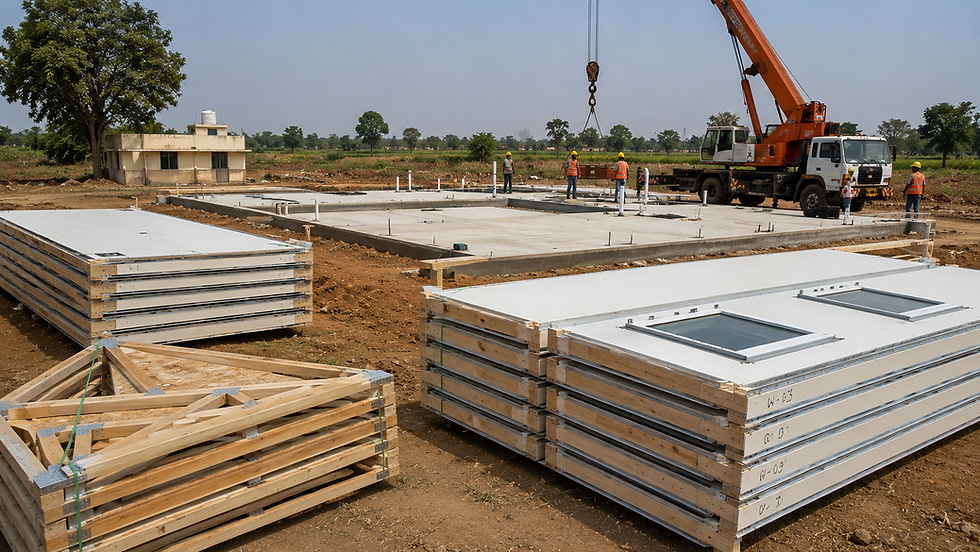
This is where the three systems diverge most dramatically. RCC construction depends on sequential on-site processes - shuttering, reinforcement, pouring, and critically, curing time that cannot be compressed regardless of labour availability, typically extending residential projects to eight months or considerably longer. Timber framing, when factory-engineered as a panelised system, can move faster than RCC but still generally involves more on-site assembly time than a fully manufactured steel system. LGSF prefab construction, with 80 to 90 percent of the building manufactured in parallel with site foundation work rather than sequentially after it, is precisely why Loom Crafts delivers complete homes in 45 to 90 days - a timeline gap measured in months, not weeks, against conventional RCC construction.
3. Seismic Performance
RCC Under Seismic Load
RCC structures, when correctly designed and reinforced to current seismic codes, perform well - but their considerable mass generates proportionally large seismic forces during an earthquake, a direct consequence of building weight, and poor-quality construction or inadequate reinforcement, unfortunately not uncommon on unsupervised sites, has historically been implicated in earthquake damage across seismic-prone Indian regions.
Timber Under Seismic Load
Timber's light weight and natural flexibility give it genuinely favourable seismic characteristics, absorbing and dissipating energy well - a property long recognised in traditional hill-station construction across the Himalayan belt.
LGSF Under Seismic Load
Steel combines light weight with ductile, ambient screw-fastened connections that flex under load rather than failing brittlely, delivering seismic performance that compares favourably with both alternatives - a significant reason LGSF has become the default for Loom Crafts projects across India's Himalayan and North-Eastern seismic zones.
4. Maintenance and Long-Term Durability
RCC requires ongoing vigilance against a specific, serious failure mode: reinforcement corrosion, where moisture ingress through surface cracking corrodes the internal rebar, expanding and cracking the surrounding concrete from within - a slow but structurally significant process requiring periodic inspection and, eventually, remedial work on ageing structures. Timber demands the most active maintenance of the three, requiring ongoing protection against termites, rot and moisture damage through regular chemical treatment and inspection, a genuine and recurring cost over a building's lifetime. LGSF, protected by its galvanised coating, requires minimal ongoing structural maintenance - there is no termite treatment schedule and no rebar to corrode, though the coating specification, as covered in our LGSF deep-dive, must be correctly matched to site exposure conditions at the outset.
5. Environmental Impact and Material Efficiency
Cement production, the core ingredient of RCC, is a well-documented significant contributor to global carbon emissions, and on-site construction typically generates more material waste through cutting, spillage and rework than factory-controlled processes. Timber, when sustainably sourced, offers genuinely favourable embodied-carbon characteristics as a renewable material, though sourcing responsibly and verifying supply chains requires diligence. Steel is energy-intensive to produce initially but is highly recyclable, and LGSF's factory manufacturing process - covered in detail in our factory guide - generates substantially less material waste than on-site construction because every section is cut to a precise digital specification rather than measured and cut by hand on-site.
6. True Lifecycle Cost, Not Just Construction Price
Comparing upfront construction cost alone misleads more often than it informs. RCC's headline construction cost is often lower than steel or timber alternatives, but must be weighed against the value of the eight-plus months of lost time, the interest cost on capital deployed over that longer period, and eventual repair costs from corrosion or cracking. Timber's material and treatment costs, plus its ongoing maintenance burden across decades, add real expense that a purchase-day comparison misses entirely. LGSF's higher-appearing upfront material cost is offset substantially by the value of a 45 to 90 day timeline - faster occupancy, faster revenue for hospitality projects, lower financing carry cost - plus minimal ongoing structural maintenance across a fifty-year design life.
💡 Loom Crafts Expert Insight — A resort developer comparing our prefab quotation against a conventional RCC bid for a boutique property near Rishikesh initially saw a materially lower RCC number and asked us to justify the difference. The honest comparison wasn't material cost per square foot - it was that our timeline let the property open and start generating room revenue roughly six months earlier than the RCC bid's realistic schedule, a revenue difference that dwarfed the material cost gap within the first season alone. Always ask any manufacturer to show you the full lifecycle comparison, not just the construction-day number.
7. Which System Suits Which Project
RCC remains genuinely well suited to multi-storey urban construction, projects requiring maximum design flexibility for future structural alteration, and contexts where local skilled RCC labour and familiarity outweigh speed considerations. Timber suits projects specifically prioritising natural aesthetics, sustainable material sourcing as a core design value, and locations where its maintenance demands can be reliably managed. LGSF prefab suits the large majority of Indian residential, farmhouse, boutique hospitality and resort cottage projects where construction speed, predictable quality, seismic performance and minimal ongoing maintenance matter more than the lowest possible headline construction-day cost - which is why it is Loom Crafts' structural system of choice.
Acoustic Performance Compared Across the Three Materials
Acoustic performance rarely features in headline construction comparisons but genuinely affects daily living comfort, and the three materials this article has compared perform differently in ways worth understanding. RCC's mass gives it strong inherent sound insulation against airborne noise, a genuine advantage in dense urban settings with significant external noise. Timber framing, being lighter and less dense, generally requires additional acoustic treatment - dedicated insulation and careful detailing - to match RCC's inherent sound performance. LGSF, similarly lighter than RCC, achieves strong acoustic performance specifically through its insulation specification, with the high-density mineral wool this pillar's LGSF and building envelope articles described contributing meaningfully to sound dampening within the wall cavity, meaning LGSF's acoustic performance depends more directly on correct insulation specification than RCC's does, but can genuinely match or approach RCC's performance when correctly specified.
Foundation Requirements Compared Across Systems
The foundation each structural system requires differs meaningfully, an important practical consideration this article has not yet addressed directly. RCC's considerable weight demands a correspondingly substantial foundation, engineered to support the structure's full mass, often requiring deeper excavation and more material than a lighter structural system needs for equivalent floor area. LGSF's significantly lighter weight allows a correspondingly lighter foundation design in many cases, a genuine cost and time saving that compounds with the structural speed advantages this article has already described, though foundation design always depends on site-specific soil conditions regardless of which structural system sits atop it, and should never be assumed identical across different sites purely because the same structural system is used.
Why Lighter Foundations Matter Beyond Cost
Beyond direct cost savings, a lighter foundation requirement can matter considerably on sites with challenging soil conditions - certain hill station or riverside sites, for instance, where a heavier RCC structure's foundation demands might require more extensive and costly ground improvement work than an LGSF structure's lighter foundation requirement would need for the same site, a further practical advantage this pillar's site-specific project examples have illustrated in locations including Coorg and Rishikesh.
Skilled Labour Availability Across the Three Methods
This article's earlier labour dependency discussion deserves one further dimension: the specific type of skilled labour each method requires, and how consistently that skill is available across India. RCC construction relies on widely available conventional masonry and reinforcement skills present in virtually every Indian region, a genuine advantage for remote sites where sourcing any specialised labour is difficult. Timber construction, by contrast, relies on more geographically concentrated carpentry skill traditions, historically strongest in specific hill station and forested regions rather than uniformly available nationwide. LGSF construction largely relocates skilled labour demand into the factory, as this pillar's factory operations article described, meaning on-site labour requirements shrink to installation crews requiring narrower, more specifically trained skills than either conventional alternative - a genuine advantage for remote sites, provided the manufacturer's factory-trained installation crews can themselves reach the site, exactly the transportation and access consideration this pillar's logistics articles addressed in detail.
💡 Loom Crafts Expert Insight — We're occasionally asked whether a client can use local labour to help with installation to reduce cost, and the honest answer is limited - LGSF panel connection and crane-assisted erection genuinely requires our factory-trained crews' specific expertise, unlike conventional construction where local labour supplementation is more straightforward. This is a genuine trade-off worth understanding: LGSF reduces overall on-site labour dependency considerably, but the labour it does require is more specialised and less substitutable than conventional construction's more broadly available trade skills.
Longevity and Renovation Flexibility Across the Three Methods
A final comparison worth making concerns how each method accommodates future renovation or modification, a genuinely practical consideration over a building's decades of eventual ownership. RCC construction, once cured, is structurally rigid and modifying it - adding an opening, removing a wall - typically requires cutting through reinforced concrete, a disruptive, dusty and structurally delicate process requiring careful engineering assessment to avoid compromising the structure. Timber framing generally allows more straightforward modification, since removing or altering timber-framed walls, while still requiring structural assessment, avoids concrete's cutting and dust challenges. LGSF sits closer to timber's flexibility than RCC's rigidity - modifying a steel-framed wall involves unscrewing and reconfiguring connections rather than cutting through solid material, though as this pillar's buyer concerns article emphasised, any structural modification should still go through proper engineering assessment rather than informal alteration, regardless of how mechanically straightforward the material itself makes the physical process.
This relative modification flexibility is one further, less obvious factor worth weighing into the overall comparison this article has built across construction time, quality control, labour dependency, sustainability, durability, cost and now longevity and renovation flexibility - a genuinely complete picture of how these three fundamentally different structural approaches compare across every dimension that matters to a homeowner's decades of eventual ownership, not just the construction-day decision itself.
Frequently Asked Questions (FAQs)
1. Is steel framing stronger than RCC?
For residential and hospitality-scale loads, LGSF delivers highly predictable, manufactured strength; RCC offers proven strength for heavier multi-storey applications. Neither is universally stronger - each is engineered to its specific load requirement.
2. Which is cheaper: steel, timber or RCC?
RCC often shows the lowest headline construction cost, but true lifecycle cost - including timeline, financing carry cost and maintenance - frequently favours LGSF once the full comparison is made.
3. Is timber construction still used in India?
Yes, particularly in hill-station vernacular architecture and specific sustainability-focused projects, though it carries a higher ongoing maintenance burden against termites and moisture than steel.
4. Which structural system performs best in earthquakes?
Both LGSF and timber benefit from lighter weight and more ductile connections than RCC, generally performing favourably in seismic zones when correctly engineered.
5. How much faster is steel prefab construction than RCC?
Loom Crafts LGSF prefab homes typically deliver in 45 to 90 days, against 8 months or considerably longer for comparable conventional RCC construction.
6. Does steel framing require more maintenance than RCC?
No - correctly coated LGSF requires minimal structural maintenance, without RCC's vulnerability to reinforcement corrosion or timber's need for ongoing termite and moisture treatment.
Conclusion
Steel, timber and RCC are not competitors in a race with one winner - they are three genuinely different engineering answers to the same question, each earning its place under different project priorities. RCC's familiarity and multi-storey capability, timber's warmth and renewability, and LGSF's speed, seismic performance and minimal maintenance each matter more or less depending on what your specific project needs to achieve. For the large majority of Indian residential, farmhouse and boutique hospitality projects prioritising speed, predictable quality and long-term durability with minimal upkeep, LGSF prefab construction is the engineered answer - not because it is newest, but because its trade-offs align with what most projects actually need.
📌 Add Loom Crafts Prefab as a Preferred Source on Google to see more of our guides in Top Stories and AI search.
Continue Reading
Continue Your Stage 3 Journey
Popular Answers and Deep Dives
Ready to Build Your Dream Home?
Loom Crafts Prefab builds on engineered LGSF construction, chosen because its trade-offs align with what most Indian homeowners and developers actually need: speed, seismic performance and minimal upkeep. We support home builders with:
A full lifecycle cost comparison against conventional RCC construction for your project
Structural drawings engineered against your site's specific seismic zone
45 to 90 day delivery with fixed, itemised pricing
A 20-year structural and rain-leakage warranty
Factory visits to see the manufacturing quality behind our steel frame
Call Us: +91 84484 40556 | Email: info@loomcrafts.com
📅 Prefer a live walkthrough? Book a free online demo at a time that suits you — our team will take you through designs, 2026 pricing and the complete build process on a video call: Book Your Online Demo
Important Disclaimer
This article is provided for general educational purposes only. Comparisons, figures and construction practices described are indicative, vary by project, location and manufacturer, and change without notice. This content does not constitute engineering or financial advice. Always consult qualified structural engineers and obtain project-specific quotations before making construction decisions.


Comments