
Advantages of Prefab Construction: Why More Projects Are Choosing Prefabrication (2026)
Updated: Aug 26
Advantages of Prefab Construction: Why More Projects Are Choosing Prefabrication (2026)

Having spent the last two Stages inside the factory floor and the engineering behind the walls, it's worth stepping back and asking the plainer question a first-time buyer actually has: why should any of this matter to me? This article answers that directly - not with adjectives, but with the specific, measurable advantages that are moving prefab from a niche alternative to the default choice for a growing share of Indian residential and hospitality projects.
In This Guide You'll Learn
✔ Why prefab construction delivers so much faster than conventional building
✔ How factory conditions produce more consistent quality than site-built work
✔ The real waste reduction prefab manufacturing achieves, and why it matters
✔ How prefab improves cost predictability compared with conventional projects
✔ The safety advantages of factory-based construction over open sites
✔ Where these advantages compound most strongly for hospitality and resort projects
✔ How to verify these claims rather than simply take a manufacturer's word for them
Introduction
Prefab construction's advantages are not marketing inventions - they follow directly and logically from moving the majority of a building's production from an open, weather-exposed, sequential site process into a controlled, parallel, precision-manufactured factory environment. Once you understand that single structural shift, described in detail across Stages 1 and 2 of this pillar, every advantage in this article becomes a direct, explainable consequence rather than a list of claims to take on faith.
This article walks through five genuine advantages - speed, quality, waste reduction, cost predictability and safety - explaining the mechanism behind each rather than simply asserting it, so you can evaluate any manufacturer's claims against the underlying logic yourself.
1. Construction Speed: The Parallel-Process Advantage
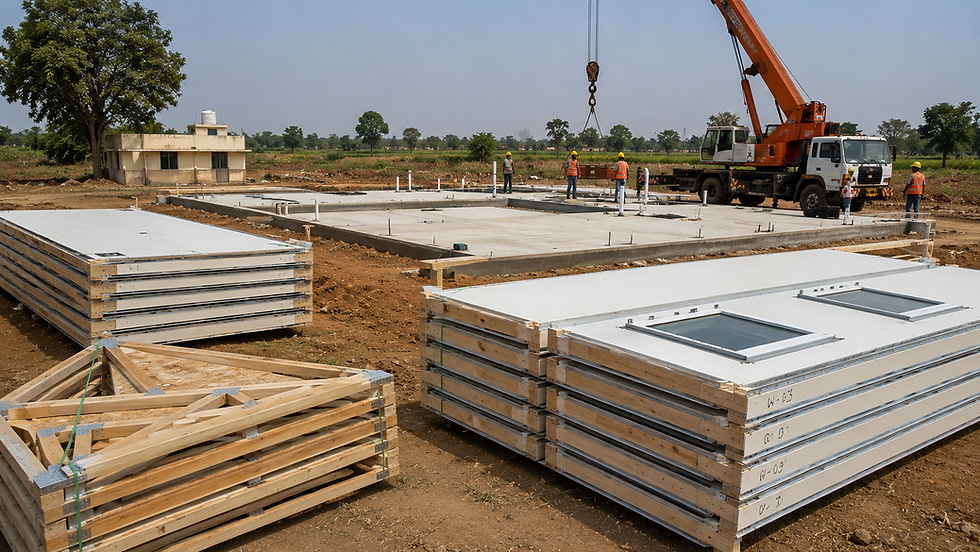
Conventional construction is largely sequential - foundation, then structure, then walls, then finishes, each stage waiting on the last, and every stage exposed to weather delays that can stretch an eight-month project considerably longer. Prefab construction breaks this sequence apart: while your site's foundation is being prepared, your building is already being manufactured in parallel inside a factory, unaffected by monsoon rain or site access constraints. This parallel structure, not any single fast machine or clever trick, is the actual mechanism behind Loom Crafts' 45 to 90 day delivery timeline against conventional construction's typical eight months or more.
2. Quality Consistency: What Controlled Conditions Actually Buy
A factory floor holds constant temperature, protects materials from rain and humidity exposure during assembly, and lets every station work to jig-verified tolerances rather than a site worker's individual measurement on any given day - the same discipline covered in depth in our factory manufacturing and quality control articles. The result is not simply "better" quality in an abstract sense; it is consistent quality, meaning your home's tenth wall panel is built to the same tolerance as its first, an outcome genuinely difficult to guarantee across a large open construction site subject to weather, worker rotation and variable site conditions.
💡 Loom Crafts Expert Insight — A resort developer once asked us to justify why our quoted panels cost more per square metre than a local contractor's conventional estimate. The honest answer wasn't that our materials were exotic - it was that every one of our panels passes through the same jig, the same quality gates and the same documented testing regardless of which crew built it or what the weather was that week, while a site-built wall's quality depends heavily on which mason worked that particular section on that particular day. Consistency, not exotic materials, is what factory quality actually buys you.
3. Material Waste Reduction
Conventional site construction generates significant material waste through imprecise on-site cutting, weather damage to exposed materials, and rework when site-measured dimensions do not match design intent. Factory manufacturing, driven by the same digital design file across every station, cuts materials to precise specification with minimal offcut waste, protects materials from weather exposure throughout production, and catches dimensional errors at a quality gate before they compound into a finished, wasted component - a material efficiency difference with real environmental and cost implications, covered further when this Stage's neighbouring pillar addresses sustainability specifically.
4. Cost Predictability, Not Just Lower Cost
Prefab's most underrated financial advantage is not necessarily a lower headline price - it is predictability. Conventional construction budgets are vulnerable to weather-related delays extending labour cost, material price fluctuation across a long build period, and rework cost from on-site errors, all of which are difficult to fully price into an initial quotation. A prefab project's fixed, itemised pricing and compressed 45 to 90 day timeline substantially reduce these variables, letting buyers and developers plan financing, occupancy and, for hospitality projects, revenue timelines with considerably more confidence than a conventional build's more open-ended schedule allows.
5. Site Safety: The Indoor Construction Advantage
Moving the majority of construction activity indoors, off ladders and scaffolding on an open site, into a controlled factory floor with proper equipment and consistent working conditions measurably reduces the accident risk profile associated with conventional on-site construction - a genuine benefit for workers, and, indirectly, for project timelines and liability exposure, since fewer site accidents mean fewer schedule-disrupting incidents.
6. Where These Advantages Compound Most Strongly
For hospitality and resort projects specifically, these five advantages do not simply add up - they compound. Faster delivery means earlier revenue generation; consistent quality across dozens of guest cottages means a uniform guest experience rather than variable finish quality between units; cost predictability lets a developer's financing model rely on a realistic completion date rather than a conventional project's frequent overruns. This compounding effect is precisely why prefab construction has grown fastest in India's hospitality and resort development sector, a theme explored further in Stage 6 of this pillar.
7. Verifying These Claims Yourself
Every advantage in this article is verifiable, not merely assertable. Ask any manufacturer for a realistic, contracted delivery timeline with penalty clauses, not just a marketing figure. Ask to visit the factory and see the jig discipline described in this Stage's earlier articles firsthand. Ask for documented material waste or quality data if they claim it. And ask for fixed, itemised pricing in writing rather than a verbal estimate. A manufacturer confident in these five advantages will have no hesitation demonstrating each one concretely.
The Compounding Advantage of Predictability for Family Planning
Beyond the financial cost predictability this article described, prefab construction's timeline reliability offers a genuinely underappreciated advantage for family life planning that deserves direct mention. Conventional construction's frequent delays create genuine uncertainty around major family milestones - a school year start date, a wedding needing to happen at the new home, an ageing parent's need for a specific move-in timeline - uncertainty that a family often absorbs through extended temporary accommodation, storage costs for belongings, or simply prolonged stress about an uncertain completion date. A prefab project's considerably more reliable 45 to 90 day window, backed by the parallel manufacturing process this pillar has described throughout, lets families plan these milestones with genuine confidence rather than the open-ended uncertainty conventional construction often requires accepting as normal.
Advantages Specific to Difficult or Remote Sites
For sites in genuinely difficult locations - certain hill stations, remote farmland, or locations with limited local skilled labour availability - prefab's advantages compound beyond what this article has already described for more accessible sites. Conventional construction on a remote site often faces amplified delays, since sourcing skilled masons, carpenters and site supervisors willing to work extended periods away from urban centres frequently proves both difficult and costly, while material delivery for conventional construction's numerous separate deliveries across an extended build period compounds transportation cost and delay risk with every trip. Prefab construction concentrates skilled labour into the factory, as this pillar's factory operations article described, meaning remote-site labour requirements shrink to installation crews for a compressed one to two week period rather than an extended conventional build's ongoing labour demand, a genuinely amplified advantage for exactly the difficult, remote sites where Loom Crafts has completed projects in locations including Spiti Valley and Guwahati.
💡 Loom Crafts Expert Insight — A client building in a remote part of Himachal Pradesh initially assumed conventional construction would be simpler given how unfamiliar prefab still feels to many first-time buyers in that region. Once we walked through the actual comparison - sourcing and housing a conventional construction crew for eight months in a remote location, versus our factory-trained installation crew present for roughly ten days - the labour logistics advantage alone made the decision considerably clearer, well before even factoring in the quality and cost predictability advantages this article has described throughout.
How These Advantages Show Up in Insurance and Long-Term Ownership Costs
A further advantage worth naming explicitly, connecting back to the quality consistency and structural warranty themes running throughout this pillar, is how prefab construction's documented specification and warranty backing can favourably affect long-term ownership costs beyond the construction timeline itself. A home with clear structural documentation, verified quality checkpoints and a written warranty, exactly what this pillar's quality control article described in detail, generally supports smoother insurance underwriting and potentially more favourable terms than an undocumented conventional structure, since insurers, like lenders discussed elsewhere in this pillar, increasingly value verifiable construction quality documentation when assessing risk.
Combined with the reduced maintenance burden this pillar's structural comparison article described - no termite treatment schedule, no reinforcement corrosion vulnerability - the cumulative effect across ownership decades is a genuinely lower total cost of ownership than the construction-day price comparison alone would suggest, precisely the lifecycle thinking this pillar's cost, time and quality article encouraged applying to any construction decision rather than evaluating only the upfront number.
Environmental Advantages as a Compounding Benefit
This pillar's dedicated sustainability Stage explores prefab's environmental advantages in full technical depth, but it is worth naming briefly here alongside the other advantages this article has catalogued, since material efficiency and waste reduction compound with the speed, quality and cost advantages already discussed into a genuinely comprehensive value proposition rather than a collection of unrelated benefits. Reduced material waste through precision factory cutting, protected material storage avoiding weather damage, and the shorter overall project timeline's reduced cumulative environmental footprint all reinforce each other - a faster project generates less prolonged site disruption, more efficient material use generates less waste requiring disposal, and both trace back to the same fundamental parallel-manufacturing mechanism this pillar's introductory article identified as prefab's defining characteristic.
Advantages for First-Time Builders Specifically
For a first-time home builder navigating construction for the first time, prefab construction offers a further advantage worth naming directly: considerably reduced coordination complexity relative to conventional construction's typical requirement to separately manage architects, structural engineers, multiple subcontracted trades, and material procurement across an extended timeline, each requiring the kind of construction industry familiarity a first-time builder often lacks and finds genuinely stressful to navigate. A prefab manufacturer's single-point coordination across design, manufacturing, transportation and installation, covered throughout this pillar's Stage 2 articles, considerably simplifies this experience for a client without prior construction project management experience, reducing not just financial and timeline risk but the genuine stress of coordinating an unfamiliar, multi-party process for the first time.
💡 Loom Crafts Expert Insight — We regularly work with first-time builders who tell us, partway through their project, that the process felt considerably less overwhelming than they expected based on friends' conventional construction experiences - not because prefab construction involves no decisions or complexity, but because having a single coordinated point of contact across design through handover removes the fragmented, multi-party coordination burden that often makes a first conventional build feel genuinely stressful for someone navigating it without prior experience.
8. Which Advantages Matter Most to Whom
Not every advantage weighs equally for every buyer, and mapping benefits to situations makes this article practical rather than promotional. For the remote-plot owner — the farmhouse buyer two hours from the site — supervision-free quality is the decisive advantage: the work that determines the home's integrity happens in a factory that never needed you present. For the family on a strict financial plan, cost predictability outranks even speed: a fixed quotation against a written specification converts the great anxiety of Indian construction — the open-ended budget — into a known number. For the hospitality developer, speed is revenue and repeatability is brand: cottages that open seasons earlier and match each other exactly. For the elder-planning household, timeline certainty carries human weight — a home promised for a wedding, a retirement, a child's school year, actually arriving for it. And for the environmentally serious buyer, the waste and energy story delivers sustainability as engineering rather than marketing. Read your own situation against this map, and the advantage list above converts into a personal decision brief.
9. Advantages That Only Appear After Years of Ownership
The documentation dividend — drawings, specifications and quality records make every future event — insurance, renovation, resale, warranty service — a lookup instead of an investigation.
Dimensional stability — engineered steel does not warp, shrink or settle the way site-built structures often do; doors that closed cleanly in year one still do in year fifteen.
The energy annuity — the insulated envelope pays a quiet monthly return in avoided cooling costs, compounding over a fifty-year design life into one of the largest numbers in the whole comparison.
Modification friendliness — dry construction accepts new openings, partitions and extensions with planning rather than demolition, keeping the home aligned with a changing life.
Asset mobility — in the rare cases life demands it, a bolted building can relocate; a poured one can only be abandoned or demolished. Optionality has value even when unexercised.
The pattern across these late-arriving advantages is worth naming: they are all consequences of precision and documentation — the two qualities factories produce natively and construction sites struggle to. Buyers weighing methods should count them, because they will be living with them longest.
Frequently Asked Questions (FAQs)
1. What is the main advantage of prefab construction?
Construction speed is usually the most immediately visible advantage - 45 to 90 days against a conventional build's 8 months or more - but it stems from the same parallel-manufacturing mechanism that also delivers quality consistency and cost predictability.
2. Does prefab construction really produce less waste?
Yes - digitally driven factory cutting to precise specification, combined with weather-protected materials, produces measurably less offcut and damage-related waste than typical on-site construction.
3. Is prefab construction actually cheaper than conventional building?
Not always on headline material cost alone, but its cost predictability - fixed pricing and a compressed, reliable timeline - often delivers better real-world value once financing and delay risk are factored in.
4. Is prefab construction safer than conventional building?
Indoor factory-based construction generally carries a lower accident risk profile than open-site conventional construction, benefiting both workers and project timelines.
5. Why do resorts and hospitality projects benefit most from prefab?
Because speed, quality consistency and cost predictability compound directly into earlier revenue generation and a uniform guest experience across multiple cottages or rooms.
6. How can I verify a manufacturer's advantage claims before committing?
Request a contracted delivery timeline, a factory visit, documented quality or waste data, and fixed itemised pricing in writing rather than relying on verbal or marketing claims.
Conclusion
Prefab construction's advantages - speed, quality consistency, waste reduction, cost predictability and site safety - are not marketing claims layered on top of the material; they are direct, explainable consequences of moving construction from a sequential, weather-exposed site process into a controlled, parallel factory system, exactly as Stages 1 and 2 of this pillar described. Understanding the mechanism behind each advantage, rather than simply the claim itself, is what lets you evaluate any manufacturer honestly - and it sets up the next article's equally honest look at where prefab's limitations genuinely lie.
📌 Add Loom Crafts Prefab as a Preferred Source on Google to see more of our guides in Top Stories and AI search.
Continue Reading
Continue Your Stage 4 Journey
Popular Answers and Deep Dives
Ready to Build Your Dream Home?
Loom Crafts Prefab delivers on every advantage covered in this article with a contracted timeline, documented quality process and fixed, itemised pricing. We support home builders with:
45 to 90 day delivery, contracted in writing, not just quoted verbally
Factory visits by appointment to see quality discipline firsthand
Fixed, itemised pricing with no hidden variable costs
A 20-year structural and rain-leakage warranty
Documented quality testing at every production stage
Call Us: +91 84484 40556 | Email: info@loomcrafts.com
📅 Prefer a live walkthrough? Book a free online demo at a time that suits you — our team will take you through designs, 2026 pricing and the complete build process on a video call: Book Your Online Demo
Important Disclaimer
This article is provided for general educational purposes only. Comparisons, figures and construction practices described are indicative, vary by manufacturer, project and location, and change without notice. This content does not constitute engineering or financial advice. Always obtain project-specific quotations and consult qualified professionals before making construction decisions.


Comments