
Transportation & Logistics: How an Entire Building Travels Safely to Your Site (2026)
Updated: Aug 26
Transportation & Logistics: How an Entire Building Travels Safely to Your Site (2026)

Between a completed, quality-verified panel sitting in factory storage and that same panel being lifted into position on your site lies a logistics operation that, while largely invisible to most buyers, genuinely determines whether your project's delivery timeline holds. This article walks through exactly how that journey works - packing, loading, route planning and delivery sequencing - and the specific challenges India's remarkably varied terrain and road infrastructure present, challenges this pillar's limitations article acknowledged honestly and this article now explains concretely how experienced manufacturers actually plan around.
In This Guide You'll Learn
✔ How prefab components are packed and secured for transport
✔ What vehicles are used, and why component size matters so much
✔ How route planning accounts for India's varied road infrastructure
✔ The specific access challenges hill, coastal and rural sites present
✔ How delivery sequencing is coordinated with site readiness
✔ What happens if a delivery route reveals an unexpected obstacle
✔ Questions to ask about your specific site's delivery logistics
Introduction: Why Transportation Deserves Its Own Article
It is tempting to think of transportation as a simple, mechanical final step - components are finished, so a truck takes them to site. In practice, transportation is a genuinely complex planning exercise, and mistakes at this stage can undo weeks of careful factory precision, whether through in-transit damage, a delivery vehicle unable to reach the site, or timing mismatches with foundation readiness that leave expensive manufactured components sitting idle. This pillar's systems and limitations articles both flagged transportation as a genuine consideration; this article explains specifically how it actually works.
1. Packing and Securing Components for Transport
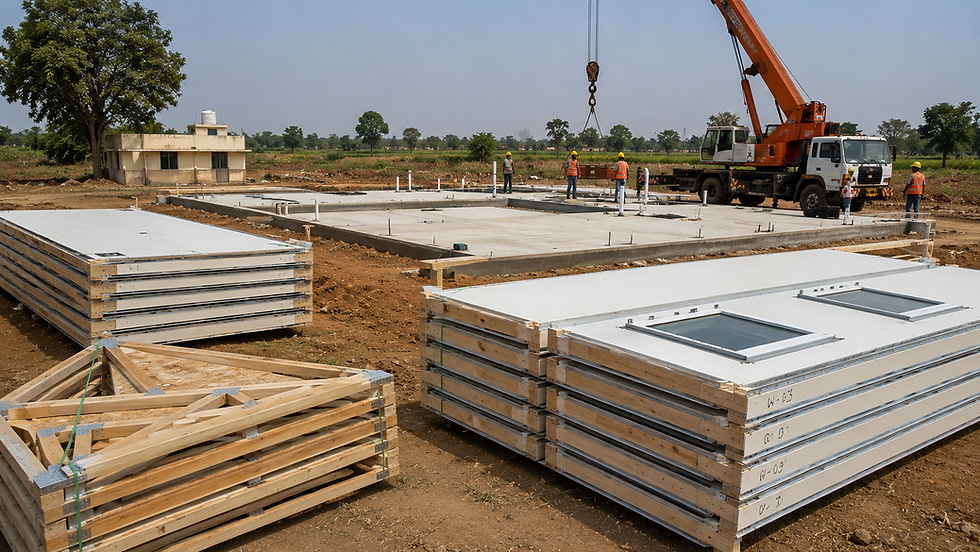
Completed wall panels, floor cassettes and roof truss components are packed for transport with protective wrapping to prevent surface damage during loading, transit and unloading, and secured to the transport vehicle using load-rated strapping and bracing specifically calculated for each component's weight and dimensions, preventing shifting during transit that could damage the component or, more seriously, compromise transport safety. Panels carrying pre-installed cladding, as this pillar's manufacturing article noted many Loom Crafts panels do, receive particular attention to corner and edge protection, since a scratched or dented finished cladding surface would require rework upon arrival that a bare structural panel would not.
2. Vehicle Selection and Component Sizing
As this pillar's systems article explained, panelised LGSF components are specifically sized to remain within standard road transport limits, meaning a typical delivery uses standard flatbed trucks rather than requiring specialised oversized-load vehicles, escort vehicles or special transport permits that volumetric modular construction's larger components would demand. Multiple panels are typically loaded per truck, with loading sequence planned so that components needed first during on-site installation are positioned for easy, early access rather than buried beneath components needed later in the erection sequence.
3. Route Planning Across India's Varied Terrain
Route planning begins well before dispatch, with the delivery route surveyed, at minimum through satellite imagery and ideally through direct site visit, to identify potential obstacles the entire truck route must navigate - bridge weight and height limits, narrow sections requiring careful vehicle positioning, sharp turns requiring wider turning radius than a standard route provides, and any seasonal access issues such as monsoon-affected unpaved sections.
Hill and Mountain Route Planning
For hill station projects such as those Loom Crafts has completed in Coorg, Ooty and Spiti Valley, route planning requires particular attention to switchback turns, single-lane sections with limited passing points, and altitude-related considerations, often necessitating smaller, more frequent deliveries with individually planned timing rather than a single large consolidated shipment a flatter, more accessible site might accommodate in fewer trips.
Coastal and Rural Route Considerations
Coastal and rural deliveries, while generally facing fewer elevation-related obstacles than hill routes, still require verification of road width and bridge capacity along rural approach roads that may not be built to the same standard as national or state highways, alongside awareness of monsoon-season flooding risk on specific routes prone to seasonal water accumulation.
4. Delivery Sequencing and Site Coordination
As this pillar's design-to-delivery article emphasised, delivery timing is coordinated specifically against confirmed foundation readiness, avoiding both the cost of components sitting idle at a factory awaiting a delayed foundation, and the more serious problem of components arriving to a site with nowhere ready to receive them. This coordination typically involves confirmed communication between the manufacturer's logistics team and the site's foundation contractor in the days immediately before scheduled dispatch, verifying readiness one final time before the delivery vehicle actually departs the factory.
💡 Loom Crafts Expert Insight — We had a project years ago where a scheduled delivery to a Wayanad site nearly proceeded before a final site check revealed the foundation contractor was several days behind schedule due to unexpected monsoon delays. Holding that delivery for four extra days, rather than sending components to sit at an unready site, saved considerably more cost and complication than it created - which is exactly why our logistics coordinators now confirm site readiness independently, immediately before dispatch, rather than relying solely on the originally scheduled timeline.
5. Handling Unexpected Route Obstacles
Despite thorough route planning, occasional unexpected obstacles do arise - road construction not reflected in available mapping data, a bridge under repair, or seasonal damage from recent heavy rainfall. Experienced logistics teams maintain contingency route options for challenging deliveries and remain in direct communication with delivery drivers throughout transit, allowing rapid rerouting if an obstacle is encountered, rather than a delivery simply stalling with no fallback plan.
6. Weather and Transportation Scheduling
Monsoon conditions specifically affect transportation scheduling beyond the route-condition considerations already discussed - heavy rainfall can affect vehicle safety on hill routes with limited visibility and traction, and scheduling deliveries to avoid the most severe monsoon periods for a specific region, where feasible within the overall project timeline, reduces both safety risk and the chance of weather-related delay. This is one further reason overall project timelines, discussed throughout this pillar, build in reasonable buffer rather than promising an unrealistically tight schedule that leaves no room for weather-related transportation delay.
7. Questions to Ask About Your Specific Site's Logistics
Before finalising your project, it is worth asking your manufacturer directly: have they surveyed or reviewed your specific delivery route, not just your site itself? What vehicle types and how many delivery trips does your project require? How do they coordinate delivery timing against your foundation contractor's actual progress? And what contingency exists if a route obstacle is discovered during transit? A manufacturer with genuine logistics experience across varied Indian terrain will answer these specifically, often referencing similar projects they have delivered to comparable locations.
8. Insurance and Liability During Transit
A further practical dimension of prefab logistics worth understanding is transit insurance - coverage protecting manufactured components against damage or loss during the journey from factory to site, a genuine consideration given that these components represent substantial value before they have even been installed. A responsible manufacturer maintains appropriate transit insurance covering their delivery vehicles and cargo, and this coverage, along with clarity about who bears responsibility for any transit damage, should be addressed explicitly in your project agreement rather than assumed. Clients are generally not expected to arrange separate insurance for the transit stage specifically, since this typically falls within the manufacturer's own logistics responsibility, but confirming this explicitly rather than assuming it removes any ambiguity if an unlikely transit incident were ever to occur.
9. Multi-Trip Deliveries for Larger Projects
For larger configurations - a 3BHK or 4BHK home, or particularly a multi-cottage resort development - delivery typically spans multiple truck trips rather than a single consolidated shipment, requiring careful sequencing so that components needed earliest in the on-site installation sequence, covered in this pillar's dedicated site installation article, arrive first, with subsequent trips timed to keep pace with the installation crew's actual progress rather than either overwhelming the site with more components than can be immediately used, or leaving the crew waiting on a delayed later shipment. This sequencing coordination becomes particularly important for resort developments building multiple cottages simultaneously, where several projects' worth of components may be moving through delivery and installation in parallel, requiring the kind of production and logistics planning discipline this pillar's factory operations article described in detail.
💡 Loom Crafts Expert Insight — On a twelve-cottage resort project near Ooty, we sequenced deliveries specifically so that each cottage's foundation-ready components arrived within a day or two of that specific cottage's foundation passing final inspection, rather than delivering all twelve cottages' worth of material at once and creating a logistical bottleneck of components waiting in staging. That kind of granular, cottage-by-cottage sequencing is exactly the planning discipline a larger multi-unit project genuinely requires, distinct from the comparatively simpler single-delivery logistics a standalone home needs.
10. Loading Sequence and Its Effect on Installation Speed
The order in which components are loaded onto delivery vehicles is planned with genuine deliberation, not arbitrarily, because loading sequence directly affects how efficiently on-site installation, covered in this pillar's dedicated installation article, can proceed once components arrive. Components needed earliest in the erection sequence - typically corner and perimeter wall panels establishing the building's footprint - are loaded last onto the truck, meaning they are unloaded first at the destination and immediately accessible to the installation crew, rather than requiring the crew to unload and shift aside components needed later just to reach the ones needed first. This loading logic, worked out during transportation planning in coordination with the installation schedule, is a small operational detail invisible to most clients but genuinely meaningful to how efficiently the visually dramatic early installation days this pillar's site installation article described actually unfold.
Coordinating Loading Sequence With Installation Crew Schedules
For larger projects requiring multiple delivery trips, loading sequence coordination extends further, with each truck's contents planned against the specific days the installation crew will need those particular components, avoiding the situation where an early delivery trip contains components not needed until considerably later in the installation sequence, occupying valuable staging space on a potentially tight site unnecessarily.
11. How Delivery Vehicle Access Requirements Are Assessed
Beyond the route survey this article described earlier, assessing whether a delivery vehicle can actually manoeuvre into position at the site itself - not just along the approach route - requires evaluating the specific plot's entrance width, any gate or boundary constraints, and available space for a truck to position, unload and, where necessary, turn around without requiring difficult or unsafe reversing manoeuvres on a public road. This site-level access assessment, conducted alongside the broader route survey during initial site evaluation, occasionally reveals the need for boundary wall modifications, temporary gate removal, or in rare cases, a slightly adjusted final unloading position requiring a short additional carry distance from truck to installation point - all planning details worth understanding before delivery day rather than discovering them as a surprise obstacle.
💡 Loom Crafts Expert Insight — We once arrived for a scheduled delivery to a Guwahati site only to find that a recently constructed neighbouring boundary wall had narrowed the plot's entrance since our original site survey months earlier - a genuine reminder that site conditions can change between initial assessment and actual delivery, particularly across a longer project timeline. We now recommend a final access confirmation shortly before dispatch specifically to catch exactly this kind of late-breaking change, rather than relying solely on an assessment conducted at the very start of the project.
12. Driver Selection and Route Familiarity
A detail rarely discussed but genuinely consequential to safe, on-schedule delivery is driver selection - assigning drivers with specific experience navigating the terrain type a given delivery route requires, rather than treating every delivery as interchangeable regardless of destination. A driver experienced with hill route driving, comfortable with switchback turns, narrow passing points and the specific handling characteristics of a loaded flatbed truck on inclines, is considerably better suited to a Coorg or Spiti Valley delivery than a driver whose experience is limited to flat, metropolitan routes, even if both are equally capable on the terrain they know well. Established manufacturers with genuine regional delivery experience typically maintain relationships with drivers and transport partners experienced in the specific terrain types their client base most commonly requires, rather than sourcing transportation opportunistically for each individual delivery without regard to route-specific experience.
This driver-route matching, alongside the vehicle maintenance standards any responsible logistics operation should maintain regardless of route difficulty, forms a further, less visible layer of the transportation planning this article has described throughout - one more reason a manufacturer's demonstrated track record delivering to terrain similar to your own site carries genuine weight beyond simply confirming that a delivery is theoretically possible.
13. Cost Factors Behind Transportation Pricing
Transportation cost, typically included within a manufacturer's overall project quotation rather than billed separately, is driven by several genuine factors worth understanding rather than treating as an opaque line item: distance from factory to site, naturally, but also route difficulty - a hill route requiring smaller, more frequent deliveries with more careful, slower driving costs meaningfully more per component delivered than a straightforward metropolitan route accommodating larger, less frequent loads. Number of delivery trips required, driven by project size and the loading sequence considerations described earlier in this article, similarly affects overall transportation cost, as does any need for specialised access solutions - a smaller secondary vehicle to transfer components from a delivery truck unable to reach a site's final approach, for instance, on a particularly constrained plot.
Understanding these cost drivers helps explain why two clients receiving otherwise similar quotations for comparable homes might see somewhat different transportation-related costs, particularly if one project sits considerably further from the factory or presents meaningfully more challenging site access than the other - a legitimate cost difference grounded in genuine logistics complexity, not inconsistent pricing.
💡 Loom Crafts Expert Insight — A client comparing notes with a friend whose home we'd built the previous year in a different state occasionally asks why their transportation-related costs differ, assuming an inconsistency in our pricing. We're always glad to walk through the specific factors - distance, route difficulty, number of trips required - because once explained concretely, the difference makes complete sense rather than seeming arbitrary, and it's exactly the kind of transparency this pillar has consistently encouraged clients to expect and request from any manufacturer.
14. Bringing Transportation Planning Full Circle
Every element this article has covered - packing, vehicle selection, route survey, delivery sequencing, driver selection, access assessment, and cost structure - ultimately serves one straightforward goal: ensuring the factory precision described throughout this pillar's manufacturing articles actually arrives at your site intact, on schedule, and ready for the installation process this pillar's dedicated site installation article details. Transportation is easy to overlook when evaluating a prefab manufacturer, since it happens largely out of sight between two more visually engaging stages, factory production and on-site erection, but the planning discipline behind it is exactly as consequential to your project's success as either of those more visible stages.
Frequently Asked Questions (FAQs)
1. How are prefab wall panels transported to site?
Typically on standard flatbed trucks, since panelised LGSF components are specifically sized to remain within standard road transport limits, avoiding the need for specialised oversized-load vehicles.
2. Does route planning happen before or after manufacturing?
Route planning and site assessment ideally begin during initial consultation, well before manufacturing, so any access constraints can inform system and component sizing decisions from the start.
3. How does delivery work for hill station or remote sites?
Often through smaller, more frequent deliveries with individually planned timing, accounting for switchback turns, narrow single-lane sections and altitude-related route considerations.
4. What happens if my foundation isn't ready when delivery is scheduled?
Experienced manufacturers confirm site readiness immediately before dispatch and will hold delivery rather than sending components to an unready site, avoiding cost and complication on both sides.
5. Does monsoon weather affect prefab delivery scheduling?
Yes - heavy rainfall can affect vehicle safety on hill routes and cause seasonal road damage, which is why realistic project timelines build in buffer for weather-related transportation delay.
6. What happens if an unexpected obstacle is found during delivery?
Experienced logistics teams maintain contingency route options and stay in communication with delivery drivers, allowing rerouting rather than a delivery simply stalling.
7. Are cladded, finished panels transported differently from bare structural panels?
Yes - panels with pre-installed cladding receive additional corner and edge protection during packing, since a damaged finished surface requires rework a bare structural panel would not.
8. What questions should I ask about my site's delivery logistics?
Ask whether the manufacturer has surveyed your specific delivery route, how many delivery trips your project requires, and how delivery timing is coordinated against your foundation's actual progress.
Conclusion
Transportation and logistics, though largely invisible to most buyers, represent a genuinely complex planning exercise spanning packing, vehicle selection, route survey, delivery sequencing and weather-aware scheduling, all coordinated to ensure the factory precision described throughout this pillar actually arrives at your site intact and on schedule. Understanding this process, and asking a manufacturer directly about their experience with routes and terrain similar to your own site, is a genuinely useful part of evaluating any prefab manufacturer before committing to a specific delivery timeline promise.
📌 Add Loom Crafts Prefab as a Preferred Source on Google to see more of our guides in Top Stories and AI search.
Continue Reading
Continue Your Stage 2 Journey
Popular Answers and Deep Dives
Ready to Build Your Dream Home?
Loom Crafts Prefab has delivered safely to hill, coastal and rural sites across 50+ Indian cities, with logistics planning built into every project from the first consultation. We support home builders with:
Route survey and access assessment before design finalisation
Delivery scheduling coordinated against your confirmed foundation readiness
Experience navigating hill, coastal and remote rural terrain
Contingency planning for unexpected route obstacles
45 to 90 day delivery with fixed, itemised pricing
Call Us: +91 84484 40556 | Email: info@loomcrafts.com
📅 Prefer a live walkthrough? Book a free online demo at a time that suits you — our team will take you through designs, 2026 pricing and the complete build process on a video call: Book Your Online Demo
Important Disclaimer
This article is provided for general educational purposes only. Logistics practices, timelines and route considerations described are indicative, vary by manufacturer, project and location, and change without notice. This content does not constitute logistics or engineering advice. Always confirm specific delivery logistics directly with your manufacturer for your exact site.


Comments