
Schools, Hospitals & Institutional Projects: Rapid Infrastructure Without Compromising Quality (2026)
Updated: Aug 26
Schools, Hospitals & Institutional Projects: Rapid Infrastructure Without Compromising Quality (2026)

This Stage's final application closes the range this pillar has explored - from individual homes through commercial ventures to institutional infrastructure serving entire communities. Schools, hospitals, training centres and workforce housing carry distinct demands from every other application this Stage has covered: heightened safety and accessibility standards, often urgent deployment timelines driven by genuine community need, and accountability to public or institutional stakeholders rather than a single private buyer's preferences alone.
In This Guide You'll Learn
✔ Why institutional projects often demand particularly urgent timelines
✔ Safety and accessibility standards specific to institutional construction
✔ How schools and educational facilities use prefab construction
✔ Healthcare facility considerations, from clinics to emergency deployment
✔ Workforce housing applications at industrial and infrastructure sites
✔ What sets institutional prefab evaluation apart from private projects
Introduction: When Speed Serves Genuine Public Need
Every application this Stage has covered benefits genuinely from prefab construction's speed advantage, but institutional applications often carry a different, more urgent character to that benefit - a school needed before an academic year begins, a healthcare facility needed to serve an underserved community without further delay, or emergency housing needed in the immediate aftermath of a natural disaster. This urgency, distinct from a private buyer's personal timeline preference, is precisely where prefab construction's core mechanism - manufacturing in parallel with site preparation, covered throughout this pillar - delivers genuine public value beyond individual project convenience.
1. Safety and Accessibility Standards
Institutional construction, particularly schools and healthcare facilities, typically operates under heightened safety and accessibility requirements beyond standard residential or commercial building codes, covered in further regulatory depth in this pillar's dedicated Stage 7 articles - fire egress requirements accounting for large occupant numbers, accessibility provisions supporting the full range of students, patients or staff who will use the facility, and in healthcare specifically, infection control and clinical functionality considerations that shape material and layout choices beyond what residential or commercial construction requires.
2. Schools and Educational Facilities
Prefab construction serves educational applications ranging from individual classroom additions to complete school campuses, with the compressed timeline this pillar has emphasised throughout offering particular value for schools needing capacity ready before a specific academic year begins, a hard deadline considerably less flexible than most private residential timelines. Acoustic performance between classrooms, covered in this pillar's wall and floor systems article, matters considerably for educational environments specifically, where multiple simultaneous classroom activities require genuine sound separation to avoid disrupting neighbouring instruction.
3. Healthcare Facility Applications
Healthcare applications span a considerable range - from smaller clinics and diagnostic centres to larger hospital facility expansions - each carrying specific requirements around clinical functionality, infection control surface specifications, and in some cases, genuinely rapid deployment for emergency healthcare capacity, a use case that gained particular global attention during recent public health emergencies internationally, where rapid-deployment healthcare infrastructure demonstrated prefab construction's genuine public health value beyond routine convenience.
Infection Control Considerations
Healthcare-specific material specification often requires surfaces and finishes supporting rigorous cleaning and infection control protocols, a consideration worth discussing explicitly with any manufacturer for a healthcare-specific project, since standard residential or commercial finish specifications may not meet the particular hygiene standards clinical environments require.
4. Workforce Housing at Industrial and Infrastructure Sites
Large infrastructure and industrial projects - highway construction, power generation facilities, mining operations - frequently require substantial workforce accommodation at remote sites for extended project durations, an application where prefab construction's rapid deployment and the reduced on-site labour requirements this pillar's applications-focused earlier sections described offer genuine practical advantage, since workforce housing itself needs to be operational quickly to support the broader project's own workforce, without becoming a construction project competing for the same limited local resources the main project also requires.
💡 Loom Crafts Expert Insight — Workforce housing projects carry a particular logic worth understanding: the housing itself needs to go up fast precisely because it's supporting a larger, time-sensitive infrastructure project that can't proceed efficiently without its workforce properly accommodated nearby. This makes prefab's speed advantage almost self-reinforcing in this specific application - the housing that houses the workers building something else needs, itself, to be built with the same urgency as the larger project it supports.
5. Emergency and Disaster-Relief Deployment
Prefab construction's speed advantage reaches its most consequential application in emergency and disaster-relief deployment, where rapid, reliable shelter provision genuinely matters for immediate human welfare following natural disasters or displacement events. While this application carries distinct considerations from the permanent, fifty-year design life structures this pillar has otherwise emphasised throughout - emergency deployment often prioritises speed and functional adequacy over the long-term architectural and finish considerations this pillar's other applications have discussed - the underlying manufacturing precision and structural engineering this pillar has described remain equally relevant to ensuring emergency shelter genuinely protects occupants adequately, not merely quickly.
6. Government and Institutional Procurement Considerations
Institutional and government-funded projects typically involve procurement processes distinct from private commercial or residential purchasing - competitive tendering, specific documentation and certification requirements, and often longer approval chains before construction can actually begin, even once a project is conceptually approved. Manufacturers with genuine institutional procurement experience navigate these processes considerably more smoothly than those accustomed only to private residential or commercial sales conversations, making this specific track record worth confirming directly for any institutional project.
7. What Sets Institutional Evaluation Apart
Evaluating a manufacturer for an institutional project benefits from the same technical diligence this pillar has emphasised throughout - structural specification, quality documentation, warranty terms - but adds institutional-specific considerations: genuine experience with the heightened safety and accessibility standards this article's earlier section described, procurement process familiarity, and often, the capacity to handle a considerably larger single project or multiple simultaneous institutional deployments than a typical private residential or even hospitality project would require.
Training Centres and Skill Development Facilities
Alongside traditional schools, prefab construction increasingly serves training centres and vocational skill development facilities, often associated with specific industrial or infrastructure projects needing to rapidly upskill a local workforce, an application sharing much of the urgency this article's workforce housing section described, since training capacity often needs to be operational quickly to support a broader project's workforce development timeline. These facilities typically require flexible, reconfigurable space supporting varied training activities, achievable within the same design flexibility this pillar's Stage 3 articles described for LGSF construction generally.
💡 Loom Crafts Expert Insight — We've supported training facility construction tied to larger infrastructure projects where the client's workforce development timeline was, if anything, more time-pressured than the main construction project itself, since skilled workers needed training well before the main project's peak labour demand arrived. It's a reminder that institutional urgency doesn't only apply to the most visible applications like schools and hospitals - workforce development infrastructure carries genuine time pressure too, often overlooked in broader conversations about institutional construction.
Long-Term Institutional Asset Planning
Unlike a private residential or even commercial buyer, institutional developers - government bodies, educational trusts, healthcare organisations - typically plan infrastructure investment across considerably longer institutional planning horizons, making the structural warranty and documented quality this pillar has emphasised throughout particularly relevant to institutional asset management and long-term budget planning. A well-documented, warranty-backed prefab facility supports institutional asset registers and maintenance planning considerably more effectively than undocumented conventional construction, connecting directly to the resale and asset value considerations this pillar's buyer concerns article addressed for private buyers, scaled to institutional asset management practice.
8. Design Standards Institutional Buildings Must Meet
Schools, healthcare facilities and public buildings are designed for the most demanding users a building can have — children, patients and the general public — and Indian codes rightly hold them to elevated standards. The National Building Code addresses occupancy-specific requirements covering fire safety and means of escape, accessibility, structural safety, lighting, ventilation and sanitation. A well-engineered prefab building meets these provisions by design, because the requirements are incorporated into the drawings before manufacturing rather than improvised on site.
For educational buildings, the priorities are generous daylight and natural ventilation in every classroom, safe circulation with adequately wide corridors and stairs, child-appropriate details such as guarded openings, and sanitation blocks scaled to enrolment. For healthcare buildings, the emphasis shifts to hygiene and serviceability: seamless washable wall and floor finishes, clear separation of clean and utility zones, provision for medical gases and specialised electrical loads in the engineered services layout, and door widths that accommodate stretchers and wheelchairs throughout.
Accessibility deserves specific mention because it is both a code requirement and a moral one: ramped entries, accessible toilets and barrier-free circulation are integrated into institutional prefab layouts as standard practice, not retrofitted.
9. Building on Live Campuses Without Disrupting Them
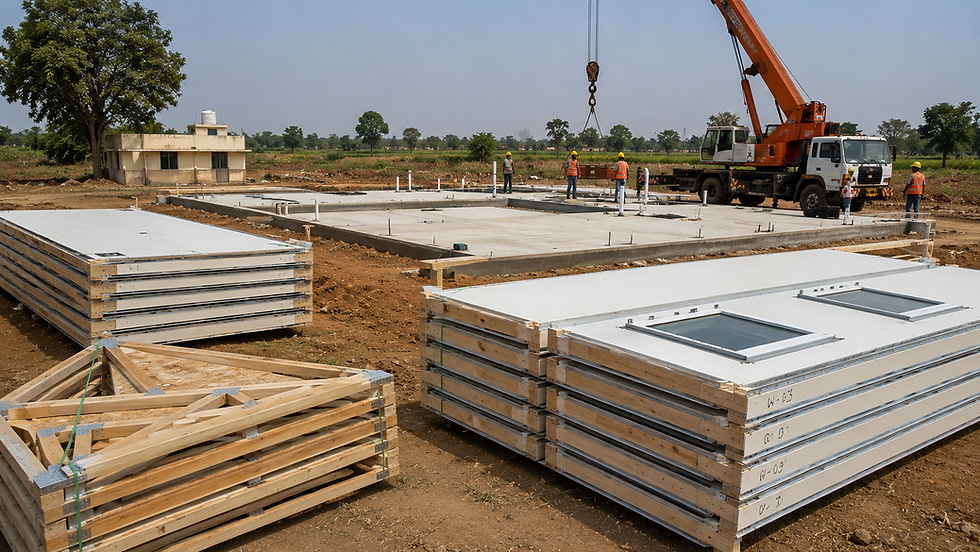
The hardest constraint for most institutional projects is not budget — it is that the campus cannot stop functioning. A school cannot suspend classes for eighteen months of conventional construction; a hospital cannot tolerate dust and vibration beside its wards. This is where off-site construction changes the equation entirely: the overwhelming majority of the work happens in a factory far from the campus, and the on-site phase is compressed into a short, tightly managed installation window.
In practice, institutions schedule prefab installations into natural pauses — summer vacations, term breaks, or low-census periods for healthcare facilities. A classroom block whose foundation is cast during the working term can be erected and finished across a vacation, opening its doors when students return. The site remains hoarded, safe and quiet in the interim, with no material stockpiles, labour camps or wet trades spread across the campus.
The same logic serves phased expansion. Institutions rarely build everything at once; enrolment grows, departments expand, funding arrives in tranches. Prefab lets a master plan be delivered block by block, each addition installed in weeks, with earlier phases fully in use throughout.
10. Durability, Maintenance & Lifecycle Value for Institutions
Institutional buyers think in decades, and rightly ask how a prefab building ages under intensive daily use. The answer lies in the engineering: galvanised steel framing that does not warp, rot or attract termites; impact-resistant board systems on high-traffic walls; and finishes selected for cleanability rather than fashion. Combined with a long structural design life and manufacturer warranties, the lifecycle proposition compares favourably with conventional construction — particularly once maintenance budgets are honestly compared.
Maintenance planning for institutional prefab buildings is straightforward: periodic inspection of sealants and roof drainage, repainting cycles for exposed finishes, and routine servicing of doors, windows and installed systems. Because wall assemblies are dry systems, localised damage — a broken board in a busy corridor — is repaired by panel replacement in hours, not by masonry work spanning days of dust and disruption.
Finally, for genuinely temporary needs — examination halls, transit campuses, disaster-response clinics — relocatability converts what would be a sunk cost into a movable asset. A building that served one campus for five years can be dismantled and redeployed rather than demolished, an option conventional construction simply cannot offer.
Frequently Asked Questions (FAQs)
1. Can prefab construction meet urgent school or healthcare facility deadlines?
Yes, often particularly well suited to urgent institutional deadlines given prefab's compressed, parallel manufacturing timeline compared with conventional construction's more sequential process.
2. Do schools and hospitals require different safety standards than residential prefab?
Yes - heightened fire egress, accessibility and, for healthcare, infection control requirements typically apply beyond standard residential or commercial building codes.
3. Is prefab construction used for workforce housing at infrastructure sites?
Yes, extensively - large infrastructure and industrial projects frequently use prefab for rapid workforce accommodation deployment given reduced on-site labour requirements.
4. Can prefab construction support emergency or disaster-relief deployment?
Yes - prefab's rapid deployment capability serves emergency shelter needs, though emergency-specific applications often prioritise speed and functional adequacy differently than permanent structures.
5. Does government or institutional procurement differ from private construction purchasing?
Yes - competitive tendering, specific documentation requirements and longer approval chains typically apply, making manufacturer experience with institutional procurement genuinely valuable.
6. What acoustic considerations matter for school construction specifically?
Sound separation between classrooms matters considerably, since multiple simultaneous educational activities require genuine acoustic isolation to avoid disrupting neighbouring instruction.
7. Are healthcare facility finishes different from standard commercial specifications?
Often yes - infection control and clinical functionality requirements may demand specific surface and finish specifications beyond standard residential or commercial building materials.
8. What should institutional developers ask a manufacturer specifically?
Ask about experience with heightened safety and accessibility standards, institutional procurement process familiarity, and capacity to handle large-scale or multiple simultaneous deployments.
Conclusion
Institutional prefab applications - schools, healthcare facilities, workforce housing and emergency deployment - represent where prefab construction's speed advantage often serves the most consequential public need across every application this Stage has explored, while demanding the most rigorous safety, accessibility and procurement diligence in return. This closes out this Stage's exploration of prefab's genuine versatility, from individual family homes through commercial ventures to infrastructure serving entire communities, all built on the same underlying LGSF engineering this pillar has explained in depth across its previous stages.
📌 Add Loom Crafts Prefab as a Preferred Source on Google to see more of our guides in Top Stories and AI search.
Continue Reading
Continue Your Stage 6 Journey
Popular Answers and Deep Dives
Ready to Build Your Institutional Project?
Loom Crafts Prefab supports schools, healthcare facilities, workforce housing and institutional developments with rapid, reliable delivery. We support institutional builders with:
Structural specification meeting heightened safety and accessibility standards
Rapid deployment for urgent timeline requirements
Experience with institutional and government procurement processes
Scalable capacity for large or multiple simultaneous deployments
A 20-year structural and rain-leakage warranty on every project
Call Us: +91 84484 40556 | Email: info@loomcrafts.com
📅 Prefer a live walkthrough? Book a free online demo at a time that suits you — our team will take you through designs, 2026 pricing and the complete build process on a video call: Book Your Online Demo
Important Disclaimer
This article is provided for general educational purposes only. Standards, practices and procurement descriptions are indicative, vary by project, institution and applicable regulations, and change without notice. This content does not constitute legal, safety or engineering advice. Always consult qualified professionals and applicable institutional standards for your specific project.


Comments