
Energy Efficiency and Running Costs: What a Prefab Home Costs to Live In (2026)
Updated: Aug 26
Energy Efficiency and Running Costs: What a Prefab Home Costs to Live In (2026)
Dreaming of a getaway of your own? Start with our complete 2026 guide to prefab holiday homes in India — geography selection, designs by family use, pricing and the rental income playbook.
Introduction
Every home has two price tags. The first - the one this pillar's budget articles dissected - is paid once, negotiated hard, and remembered forever. The second is paid monthly, negotiated never, and barely examined: the running cost, the quiet ledger of electricity, water, servicing and the thousand small operating decisions that, across a fifty-year ownership, adds up to a sum rivalling the first price tag - and in energy-hungry conventional homes, exceeding it. This article is about the second price tag: what a prefab home actually costs to live in, why the number runs structurally lower than conventional equivalents, and how the owner's choices and habits move it further.
The engineering stage built this article's physics: the envelope piece showed how the insulated assembly shrinks the heat load your appliances fight, and the smart home article mapped the monitoring and solar layers. Here, those construction facts convert to the owner's units - rupees per month, units per season, payback years - alongside the operating chapters those articles deferred: where household electricity really goes, right-sizing the machines, the everyday loads, water's own bill, the habits worth their percentage, and the whole-life ledger that closes the case.
The stakes justify the twenty minutes: the gap between an efficient and an inefficient home of identical size, in most Indian tariff regimes, runs to lakhs per decade - money that either compounds in your accounts or evaporates through an uninsulated roof. Your home already made the biggest efficiency decisions at the factory; this article is about collecting the dividend in full.
In This Guide You'll Learn:
1. The Second Price Tag: What a Home Costs to Run
Name the ledger's lines first, because what is named gets managed. A home's running cost stacks: electricity (the dominant line in most Indian households, and this article's main character), water and its pumping, cooking fuel, the servicing-and-consumables spend the maintenance guide already sized in its favour, insurance, and - the line conventional ownership hides in - the repair drag of buildings that fight their owners. Across the fleet's owner reports, a Loom Crafts home's full operating ledger runs conspicuously light on the last line and structurally light on the first, for reasons the coming sections price - and the whole stack, for a typical family home, settles into a monthly figure that surprises visitors from conventional houses of the same size in the same colony.
Two framing habits serve the whole article. Think in loads, not bills: a bill is an effect; the loads - the heat your AC removes, the water your pump lifts, the standby your electronics sip - are causes, and causes are where owners have leverage. And think in decades, not months: a few hundred rupees monthly is invisible; the same figure compounded across thirty years at rising tariffs is a car, a renovation, a corpus - which is why the budget stage called the envelope the project's best-paid worker and why this article ends at the fifty-year ledger. The second price tag rewards exactly the literacy the first one did: read it in causes and decades, and it becomes steerable.
2. Where the Electricity Actually Goes
Open the household's energy anatomy, because intuitions here are reliably wrong. In a typical Indian home with air conditioning, the thermal loads dominate everything: cooling (and heating, in the hills) commonly claims the largest single share of annual consumption - often a third to half in the plains' AC months - with water heating the strong second in winter-bathing households. The middling tier: refrigeration (modest per hour, relentless per year), pumping, and the kitchen's electrical appliances. The long tail everyone overestimates: lighting - transformed by LEDs into a single-digit percentage in most homes - and the electronics whose individual sips matter mainly through standby's around-the-clock persistence.
The anatomy dictates the strategy, and it is this article's core logic: efficiency effort should follow the loads. The thermal half is where the envelope already fought your biggest battle (next section) and where appliance sizing and behaviour move the largest remaining rupees; water heating rewards its own small kit of measures; the middle tier rewards purchase-day star-label discipline; and the tail rewards habits costing nothing. Owners who invert this - agonising over bulbs while an oversized AC short-cycles against a west window - are managing the anatomy upside down. The sections now walk it right side up, biggest muscle first.
3. The Envelope Dividend, Measured in Bills
The construction stage's promise now appears where owners can audit it: on the electricity bill. The mechanism, compressed from the envelope article: your Rockwool-wrapped, airtight, UPVC-sealed assembly admits a fraction of the heat a conventional roof-and-wall set conducts, so the air conditioner's job shrinks from fighting a continuous invasion to holding a defended position - shorter run times, longer idle stretches, smaller capacities sufficient in the first place. The fleet's owner-reported pattern, stated with the honesty the topic deserves: cooling-energy reductions commonly between a third and a half against comparable conventional rooms, larger against bare-roof construction, with the mirror-image savings on hill-station heating - the Ooty heater that naps.
Translate to rupees and the dividend compounds three ways. Directly: the avoided units, month after month, at whatever your tariff does - and Indian tariffs historically do one thing. Structurally: the smaller AC capacities the load permits cost less to buy, and efficient part-load running extends their service lives - the appliance budget and the energy budget shaking hands. And optionally: the low load makes modest solar sufficient (Section 6's arithmetic starts smaller because the envelope finished first). The owner's role in this dividend is purely custodial - the maintenance guide's seals-and-gaskets walks keep the airtightness earning - and the collection is automatic. Of every rupee this article discusses, these are the ones you cannot fail to receive; the rest of the guide is about the ones you can.
4. Right-Sizing the Machines: ACs, Geysers, Pumps
The purchase decisions that set your consumption for a decade deserve their engineering minute. Air conditioners: size to the insulated room's actual load, not the tonnage folklore built for leaky construction - oversized units in efficient rooms short-cycle, dehumidify poorly and waste their premium; your project team or an honest dealer's load calculation will typically land a size class below the colony's habit, and the inverter-type compressors that modulate to the envelope's gentle demand are this building type's natural partners, star ratings paying their premium back fastest exactly where run-hours are long. Geysers: sized to the bathroom's real draw rather than maximal fear, on the smart schedules the automation article set, with the hard-water anode care the maintenance guide flagged keeping efficiency from silting away.
Pumps and the heavy tail: the pump sized to the actual head and flow (the borewell dealer's next-size-up instinct costs every filling cycle), tank automation ending the overflow's pure waste, and the appliance fleet - refrigerator, washing machine - bought on the star label's lifetime arithmetic rather than the sticker price's afternoon logic, since the running-cost gap between label classes repays the purchase gap several times across a service life. The section's rule compresses to one line worth carrying into every showroom: in an efficient home, buy for the load you have, not the load the salesman imagines - the envelope already made your loads smaller than his experience, and the right-sized machine is the cheaper one twice.
5. Lighting and the Everyday Loads
The smaller lines, managed in passing. Lighting: the LED transition plus the interiors playbook's layered design - task light where needed instead of ceilings blazing everywhere - plus the automation article's schedules and sensors has already reduced this once-major line to single digits; the remaining owner moves are daylight (the free fixture your window design installed - use it before the switch), warm-and-dimmed evenings that consume less while living better, and outdoor lighting on sensors and timers rather than dusk-to-dawn habit. Fans: India's true climate workhorse earns its efficiency respect - the BLDC-motor generation runs on a fraction of the old induction draw, and at a fan's annual run-hours the upgrade arithmetic is among the fastest paybacks in the house.
The everyday tail: standby power - the set-top boxes, chargers and electronics sipping around the clock - answered by the smart plugs and switched points your electrical mapping provided (the away scene and goodnight scene already shed it, if the automation article's routines run); the kitchen's electrical loads managed by use rather than anxiety; and the one everyday load worth promoting rather than trimming - ventilation, whose extractors' small draw protects the envelope's vapour management, per the running theme that some watts are structural. None of this tail moves lakhs; together, on the monitoring section's dashboard, it moves the graph visibly - and the household that manages its tail has usually, by the same attention, already mastered its head.
6. Solar: From Provision to Payback
The provisions round's conduits now meet their economics. The 2026 case for rooftop solar on a prefab home is unusually clean, because the usual frictions were engineered out: the roof slope oriented at design, the structure rated for the array, conduits run and inverter space allocated - so installation is the weekend event the smart article promised, not a retrofit project. The sizing logic starts from this article's earlier sections: the envelope's low load and the right-sized machines mean a modest array covers a meaningful share of consumption - and modest arrays are where cost-per-unit and roof-fit are kindest. Add the policy layer - net metering and subsidy schemes where your state currently runs them, checked at decision time since they move - and typical household paybacks land in the single-digit-years class, after which the roof works for free through the panels' multi-decade warranties.
The load-shifting habits multiply the return: the geyser, pump and heavy daytime loads scheduled into sun hours (the automation already knows how), EV charging at the provisioned carport point drinking noon instead of tariff, and - for the households that add storage on the provisioned battery space - the evening peak served from the afternoon's surplus. The strategic summary the smart article previewed and this one prices: measurement first, envelope already done, right-sizing done, then solar - in that order each step shrinks the next one's required spend, which is why the efficient home's path to very low net bills costs a fraction of the brute-force route. The sun, on a prepared roof, is the second price tag's best negotiator.
Loom Crafts Expert Insight: A Bangalore client runs the fleet's favourite controlled experiment: for six years she has kept both her conventional-construction city flat and her Loom Crafts garden home on the city's edge - similar floor areas, same family, same appliances bought in the same seasons - and, being a data scientist by profession, logs both electricity accounts monthly. Her running six-year averages, shared with permission because she enjoys the disbelief: the prefab home consumes 41 percent fewer units annually than the flat despite hosting the family more days, its summer cooling line runs at under half, and since her modest rooftop array went onto the waiting conduits in year three, the home's net annual electricity spend has hovered near what she calls pocket-money levels - while the flat's bill climbs with every tariff revision. Her conclusion, delivered at a client meet, is this article in one sentence: the flat pays the tariff; the house mostly declines to.
7. Backup Power Without the Bleed
Backup is where Indian homes quietly leak money in three ways this home's design plugs. Conversion losses: every unit cycled through an inverter-battery system pays an efficiency toll, so the first economy is needing backup less - the envelope home rides through cuts comfortably (rooms hold their temperature; the insulation is a thermal battery that charges free), meaning smaller essential loads and shorter genuinely critical windows. Standby and charging drag: the backup system itself consumes around the clock, which sizing discipline answers: the essentials circuit your electrical design provisioned carries what matters (network, security, lights, fans, the refrigerator) rather than the whole board, so the battery bank - and its charging draw, and its replacement-cycle cost - stays honest.
And the fuel trap: the diesel generator's per-unit cost embarrasses every tariff, which is why the design pushes it to last resort - the solar-plus-storage pairing on the provisioned spaces serving the daily cuts silently and renewably, with any generator reserved for the remote site's rare long outage, per the farmhouse stewardship stack. Battery chemistry deserves its ledger line: the lithium generation's higher purchase price buys cycle lives and efficiencies that undercut the old lead-acid economics across ownership, and the maintenance guide's quarterly backup minute protects whichever chemistry you run. The section's principle mirrors the whole article's: resilience, like comfort, is cheapest when the building itself does most of it - and this building does.
8. Water: The Other Utility Bill
Water's costs hide in three places, each already half-solved by earlier stages. The pumping line: every litre lifted is electricity spent, so the water-intelligence layer - tank automation ending overflow's pure loss, pump protection, leak sensors catching the slow secret drip that runs a motor and a bill for months - is energy policy wearing plumbing's clothes; the smart article's most Indian category earns its keep here monthly. The consumption line: the Jaquar generation's aerated fittings deliver service at lower flows without asceticism, the drip irrigation from your landscaping sips where hoses flooded, and the greywater-and-mulching habits of a thoughtful garden stretch every pumped litre.
And the sourcing line, where the provisions round's rain harvesting graduates from compliance checkbox to working asset: the roof's monsoon harvest, stored or recharged per your system, offsetting borewell pumping and tanker dependence - with the tanker-supplied colonies' arithmetic making harvesting paybacks embarrassingly short wherever that market operates. The hard-water regions add their efficiency footnote: scale is an energy thief (the furred geyser element, the choked aerator), so the treatment and descaling rhythms of the maintenance guide protect this ledger too. Water rarely stars in running-cost conversations; across a Indian ownership's decades of pumping, purifying and occasionally buying it, it earns its section - and this home, characteristically, pre-argued most of it.
9. Habits: The Free Ten Percent
Hardware set, the human layer takes its share - typically the cheapest ten-or-so percent on any household's graph, collected through habits that cost nothing:
Set points with sense - each AC degree costs measurably; the insulated room holds a moderate set point so comfortably that the old arctic settings reveal themselves as leaky-building trauma, unlearnable in a season.
Fan-first, AC-second - the BLDC fan's pittance often delivers the comfort the AC was reflexively asked for; the pairing (AC moderate, fan circulating) outperforms either alone per rupee.
Curtains as equipment - the west window's blind drawn through the afternoon is free tonnage; the winter hill home's opened south glazing is free heating - the design stage installed these controls, and hands operate them.
Full loads and sun hours - washing machines run full and, in solar households, at noon; the geyser heats to schedule, not standby; the pump fills to the automation, not the memory.
Doors closed, scenes used - conditioned air kept where it was paid for, and the goodnight and away scenes actually pressed - the automation only saves when invoked, and one press shedding a houseful of standby is the easiest habit in the book.
And the seasonal reset - filters cleaned (a choked AC filter taxes every hour), fridge coils dusted, the maintenance guide's small services done - upkeep and efficiency being, as usual, the same walk.
10. Monitoring: Managing What You Measure
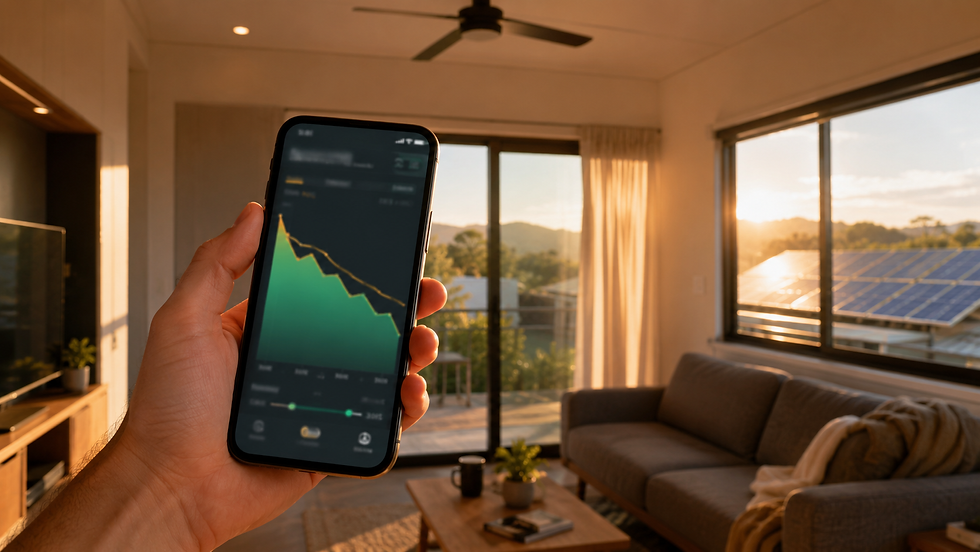
The smart article's first energy commandment returns as the running-cost keystone: measurement converts everything above from theory to feedback. The energy monitor at the distribution board - the modest device the provisions made trivial to add - turns the monthly bill's verdict into a live, per-circuit story: the graph that shows the geyser's schedule working, the standby tail shrinking after the smart plugs went in, the old refrigerator's guilt exposed (the Bangalore client's monitor famously indicted hers within a fortnight), the solar array's generation meeting the load curve. Households that can see consumption reliably trim a further meaningful slice through visibility alone - the free percentage that precedes any spend.
The practice that makes monitoring stick is lightweight: a monthly five-minute glance (the maintenance log's energy line - three numbers: units, solar generation if any, anything anomalous), season-on-season comparison rather than day-to-day noise, and the anomaly habit - an unexplained baseline jump is a diagnostic gift, usually naming a failing appliance, a stuck automation or the leak the water section warned of, weeks before the bill would have mumbled it. Measurement also settles the household's efficiency debates with data instead of opinion, which spouses report is worth the device's price alone. Manage what you measure; this home made measuring easy; the ledger does the rest.
11. The Running-Cost Comparison: Prefab Versus Conventional
Assemble the comparison the relatives will ask for, line by honest line. Electricity: the envelope dividend's third-to-half cooling reduction, compounding with right-sized machines and solar-readiness - the ledger's decisive gap, widening with every tariff revision, per the Bangalore experiment's 41 percent. Maintenance and repair: the previous articles' hours-per-year and consumables-only reality against conventional ownership's repaint cycles, seepage campaigns, termite subscriptions and the repair drag that conventional budgets learn to stop itemising - the second-largest gap and the least advertised. Water: modest advantages from the intelligence layer and harvesting, roughly comparable base consumption. Insurance: comparable classes, with the documentation advantage occasionally pricing kindly. Cooking, connectivity, the life lines: identical - houses do not cook the dal.
Net the stack and the pattern across owner reports is consistent: total operating costs for the prefab home running meaningfully below the conventional equivalent - the electricity and upkeep lines doing the work - with the gap's absolute size scaling with climate severity and AC dependence, largest exactly where Indian housing is growing fastest. The comparison's honest caveat mirrors the timeline article's: the gap is conditional on collecting the dividends - the seals maintained, the machines right-sized, the scenes pressed; an efficient building run with inefficient habits narrows its own case. But run as designed, the second price tag's verdict matches the first one's from the budget stage: the factory-built home is not the expensive choice wearing modern clothes - it is the cheaper choice on both tags, and the second tag compounds.
12. Whole-Life Cost: The Fifty-Year Ledger
Close the account the way the lifespan article closed the clocks - across the full horizon. Whole-life cost stacks four columns: acquisition (the first price tag, settled at the budget stage), operation (this article's monthly lines, compounded across decades at rising tariffs), renewal (the lifespan article's replacement calendar - appliances several times, consumables on schedule, one recoat or two, capitals untouched), and the end-column conventional accounting forgets: residual value, where the documented, maintained, still-dignified home holds its worth. Run a fifty-year family ownership through the four columns and the operating and renewal advantages this stage has priced typically sum to a figure in the same order as the acquisition cost itself - the second price tag, fully compounded, buying the home again.
Which reframes, finally, every efficiency decision this article discussed: the envelope was not a construction upgrade but a fifty-year annuity; the star-label premium and the solar array are not green gestures but the ledger's best instruments; the habits and the monitor are the free management fee on the whole portfolio. The Knowledge Center's financial articles began by teaching you to buy this home well; this one ends the arc by showing it was also the cheaper home to own - and the stage's remaining articles complete the ownership picture: growing the home when the family asks (next), and the one-page checklist that keeps all of this earning (last). The ledger is open; it reads in your favour; keep it so.
Frequently Asked Questions
How much cheaper is a prefab home to run than a conventional house?
The decisive lines are electricity - cooling reductions commonly between a third and a half from the insulated envelope, before right-sizing and solar compound it - and upkeep, where hours-per-year maintenance replaces conventional repaint-and-repair cycles. Owner comparisons like the six-year two-home experiment in this article report total consumption gaps around forty percent; the exact figure scales with climate and AC dependence, and with actually collecting the dividends.
Do prefab homes really need smaller air conditioners?
Yes - size to the insulated room's calculated load, not the tonnage folklore built for leaky construction: the envelope's reduced heat gain typically lands requirements a size class below colony habit, and inverter-type units modulating to that gentle load run cheapest and last longest. Oversized ACs in efficient rooms short-cycle and dehumidify poorly - the rare case where buying bigger performs worse twice.
Is rooftop solar worth it on a prefab home?
Unusually so, because the frictions were engineered out: oriented roof, rated structure, conduits and inverter space waiting - so installation is simple and the envelope's low load lets a modest array cover a meaningful consumption share. With current net-metering and subsidy regimes (check your state's at decision time), typical household paybacks land in single-digit years, after which the panels' multi-decade warranties work free.
What uses the most electricity in an Indian home?
Thermal loads dominate: cooling (and hill-station heating) commonly a third to half of annual consumption in AC households, water heating the strong second in winter, then refrigeration and pumping in the middle tier - with lighting, post-LED, down to single digits and electronics mattering mainly through round-the-clock standby. Efficiency effort should follow this anatomy: envelope and machine-sizing first, habits and tail last.
How do power cuts affect an efficient home's costs?
Less than anywhere: insulated rooms hold their temperature through outages (the envelope as thermal battery), so the essentials circuit stays small, the inverter bank honest, and the diesel generator - the ledger's worst per-unit line - reserved for the remote site's rare long outage, with solar-plus-storage on the provisioned spaces serving daily cuts silently. Resilience is cheapest when the building does most of it.
Does the energy monitor really save money, or is it a gadget?
It is the keystone: households that can see per-circuit consumption reliably trim a further meaningful slice through visibility alone - failing appliances exposed, schedules verified, standby tails shrunk, anomalies caught weeks before the bill mumbles them. A monthly five-minute glance and three logged numbers convert every other measure in this article from theory to feedback; of the smart layer's whole catalogue, it is the purest payback.
What habits make the biggest difference to bills?
Set points at sensible levels (each AC degree costs measurably, and insulated rooms hold moderate settings comfortably), fan-first cooling with the AC as partner, curtains operated as the equipment they are, heavy loads scheduled into solar hours, scenes actually pressed to shed standby, and the seasonal filter-and-coil cleanings that keep every machine honest. Together the human layer is typically a free ten percent.
Over decades, how much does efficiency actually add up to?
Run the fifty-year ledger - operating savings compounding at rising tariffs, renewal savings from the consumables-only maintenance reality, residual value held by the documented home - and the total advantage typically reaches the same order as the home's purchase price itself: the second price tag buying the home again. The envelope was never a construction upgrade; it was a fifty-year annuity with a comfortable house attached.
Conclusion
The second price tag reads, in an engineered home, like the first one did: itemised, steerable and structurally in your favour. The envelope collects its dividend automatically; the machines, right-sized, stop overpaying; the sun works a prepared roof; the water thinks; the habits and the monitor gather the free percentages; and the fifty-year ledger nets it all to a sum that rivals the purchase price - kept, not spent. The house that cost less to build, it turns out, was also the house that costs least to live in; the tariff, as the Bangalore experiment put it, is mostly declined.
Two articles complete the stage: the home's capacity to grow when the family does - the expansion provisions finally coming due - and the one-page seasonal checklist that keeps every dividend in this article collecting. The ledger favours the attentive; the next pages keep you so.
Loom Crafts Price Guide 2026
For readers budgeting a project, here are Loom Crafts' current starting prices across the full range of factory-built modular homes and cottages (as per the 2026 catalogue):
Studio, Single Room Cottages & Glamping Pods — ₹8.5 lakh to ₹30.5 lakh
1 BHK Modular Homes — ₹18 lakh to ₹34.5 lakh (12 designs incl. ModAlpine, AlpineVilla, Barn House, SaltBox, A-Frame, Cabana)
2 BHK Modular Homes — ₹19.67 lakh to ₹47.3 lakh (incl. ModAlpine, AlpineVilla, Vista, BarnHouse, ModRoom XL, Prism, Aurora, A-Frame)
3 BHK Modular Villas — ₹41.6 lakh to ₹56.75 lakh (incl. BarnHouse, ModAlpine, Concept Home, Cabana A)
4 BHK Luxury Prefab Villas — ₹91.5 lakh to ₹1.11 crore (Double A-Frame, 2,316–3,476 sq ft)
Prices are ex-works and exclusive of GST at 18% and transportation; installation is included. Foundation/plinth is in the client's scope unless an optional foundation system is selected. Payment follows a 25/25/25/25 milestone plan, production takes 30–60 days depending on size, and every structure carries a 20-year structural & rain-leakage warranty with a 50+ year design life.
Current model-wise pricing and floor plans are available in the downloadable catalogues on loomcraftsprefab.com.
📌 Add Loom Crafts Prefab as a Preferred Source on Google to see more of our guides in Top Stories and AI search.
Continue Reading
Ready to Build Your Dream Home?
Loom Crafts Prefab builds homes whose second price tag was engineered before the first was signed - insulated envelopes cutting cooling loads by a third to half, solar-ready roofs, right-sized systems and the monitoring fabric that keeps every dividend visible. 600+ homes across 50+ cities, and owners with electricity bills they frame. Ask us for the running-cost conversation; it is our favourite arithmetic.
Call us: +91 84484 40556 | Email: info@loomcrafts.com | Website: www.loomcraftsprefab.com
📅 Prefer a live walkthrough? Book a free online demo at a time that suits you — our team will take you through designs, 2026 pricing and the complete build process on a video call: Book Your Online Demo
Important Disclaimer
This article provides general information on home energy efficiency and running costs as of 2026 and is intended for educational purposes only. Actual consumption, savings, tariffs, subsidies, paybacks and costs vary by project, climate, usage, equipment and policy, and figures described reflect typical or reported client experience rather than guarantees. Always verify current tariffs, schemes and equipment specifications, and rely on your project's written documentation.


Comments