
Smart Home Features Worth Adding to Your Prefab Home: The Complete Guide for India (2026)
Updated: Aug 26
Smart Home Features Worth Adding to Your Prefab Home: The Complete Guide for India (2026)
Weighing up a getaway of your own? See our complete 2026 guide to prefab holiday homes in India — geography selection, designs by family use and the rental income playbook.
Introduction
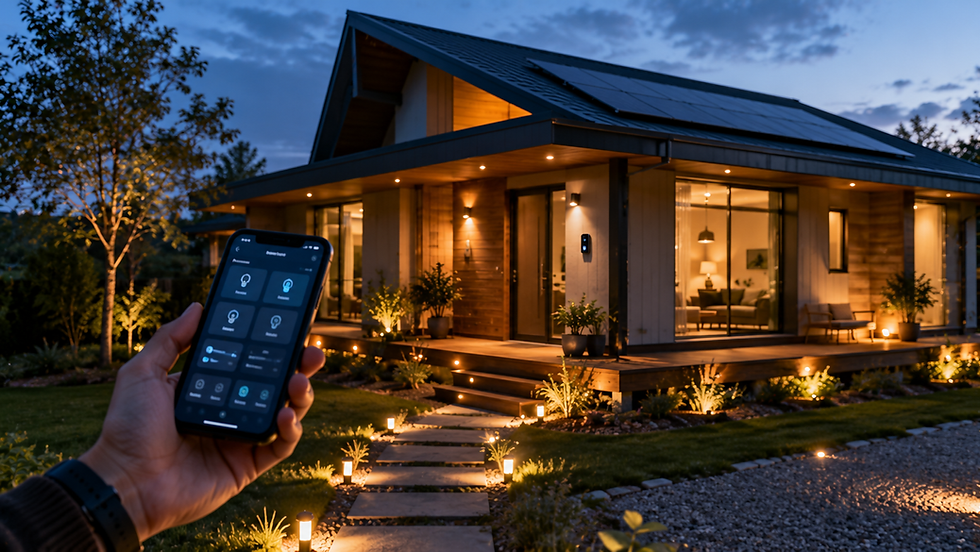
The final layer of the design stage is intelligence - the automation, security, energy and comfort technologies that have moved, over the past decade, from gadget novelty to genuine household infrastructure. In 2026, a thoughtfully specified smart layer is no longer about impressing guests with a voice-controlled bulb; it is about a home that guards itself while you sleep, spends less electricity than it used to, warns you about the water leak before the ceiling does, and welcomes you back to a farmhouse that has already cooled the bedroom and filled the tank.
It is also a layer drowning in marketing, where the genuinely valuable and the gimmick sit on the same shelf at similar prices. This guide is a filter as much as a menu: what smart actually means, which categories earn their cost in an Indian home, what belongs in the factory-built fabric versus the plug-in layer, what a farmhouse needs that a city home does not, what to skip entirely, and how to budget and future-proof the whole layer without marrying a technology that will be obsolete before your first repainting.
As with every guide in this stage, the prefab advantage runs throughout: the wiring, conduits, points and provisions that make a smart home reliable are manufactured into the panels when decided early - which makes this article, quite literally, the last set of decisions to carry into your design freeze.
In This Guide You'll Learn:
1. What Smart Actually Means - and What It Does Not
Strip away the marketing and a smart home does exactly four useful things. It senses - occupancy, temperature, water levels, motion at the gate, current flowing through a circuit. It acts - switching, dimming, locking, pumping, cooling. It informs - the notification that the geyser was left on, the camera clip of the delivery, the month's consumption graph. And it automates - connecting sensing to action so the household's routines run themselves: lights that follow the evening, a pump that stops at a full tank, an AC that pre-cools before arrival. Every worthwhile feature in this guide is one of these four verbs wearing a product name.
What smart does not mean is complexity for its own sake. The correct test for every candidate feature is brutally simple: does it remove a real chore, a real risk or a real cost from this specific household - and will the least technical member of the family use it happily? A smart lock that ends the spare-key anxiety passes for almost everyone. A refrigerator that tweets its temperature passes for almost no one. Hold every rupee of the smart budget to that test and the layer you build will be the rare kind: technology the family stops noticing because it simply works.
2. The Prefab Advantage: Wiring Intelligence In at the Factory
Smart home reliability is decided less by the devices than by what is inside the walls - and this is where a factory-built home holds a structural advantage over every retrofit. During your design window, the smart layer's fabric is specified and manufactured in: neutral wires at every switch position (the unglamorous detail that determines which smart switches will actually work), conduit runs with pull-string generosity from the distribution board to every corner that might ever want a wire, camera and doorbell points with power where they belong, the access point positions that will carry the Wi-Fi, sensor provisions at tanks and wet areas, and the changeover wiring that backup power needs.
The result is a home where the smart layer clips onto prepared infrastructure instead of fighting the building - no surface trunking crawling along fresh walls, no extender plugged into a bedroom socket apologising for the dead zone, no electrician's third visit chasing a neutral. And because the fabric is generic - conduits, points, capacity - rather than brand-committed, the home stays open to whichever ecosystem and devices the family chooses now or swaps to later. The devices of 2035 are unknowable; the conduit that will carry them costs a few hundred rupees today. This is the entire philosophy of the smart layer in one sentence: build the fabric permanent, keep the gadgets replaceable.
3. Security and Access: Locks, Cameras and Video Doorbells
Security is where smart earns its keep first in most Indian households, and the worthwhile stack is short and proven:
The smart main-door lock - fingerprint, PIN and app access with physical key backup ends the spare-key economy: family members arrive without coordination, the cook gets a code that works at her hours, the code retires when arrangements change, and the door that was left unlocked locks itself. For most families this is the single highest-satisfaction smart purchase in the home.
The video doorbell - see and speak to the gate from the sofa, the office or another city; deliveries, sales visits and unknown callers all become decisions made with information. On plots with a compound gate, pair it with a gate-release for full remote courtesy.
Cameras with judgement - the entrance, the gate, the driveway and the rear approach - covering approaches, not private life. Choose local-plus-cloud recording, night vision that actually performs, and positions decided at design so power and mounting are built in.
Sensors on the openings - door and window sensors on the vulnerable points, a motion sensor covering the main hall, and a siren with local presence - armed automatically by the away scene rather than by memory.
The away illusion - lighting automation's security cameo: evening lamps that run their normal choreography while the family is in Manali, the oldest burglar deterrent in the world, now self-operating.
One discipline completes the stack: the alerts must reach more than one phone, and someone local - a neighbour, a caretaker, the society guard - should be part of the response plan. A camera that notifies a family asleep in another time zone is a diary, not a defence.
4. Lighting Automation That Earns Its Keep
Your interiors playbook already built the lighting in layers and circuits; automation is the modest, high-value crown on that work. The features that survive the honeymoon: smart switches on the main circuits (keeping every light workable from the wall - the non-negotiable that keeps guests, grandparents and power-cut recoveries sane), dimming schedules that warm and lower the evening automatically, motion-sensed lighting exactly where fumbling is the alternative - the night path from bed to bathroom, the wardrobe interior, the entrance porch that greets arrivals hands-free - and the scene switches that collapse whole moods into one press: dinner, movie, goodnight, away.
The restraint list matters as much: individually app-controlled colour bulbs in every room photograph well and annoy daily; automation that fights manual override teaches the family to distrust it; and any lighting logic the household cannot operate during an internet outage has failed the design brief. Automate the routines, keep the switches honest, and lighting becomes the smart layer's quietest success - noticed only on the day it stops being there.
Loom Crafts Expert Insight: A Bangalore client with a newborn asked us for exactly one lighting automation in her entire home: a motion-sensed floor-level glow from the master bed to the nursery and bathroom, dim enough to keep everyone half-asleep, timed to the night hours only. No app, no voice, no colour scenes - one sensor, one warm strip, wired into the panel at factory. She later told us that single feature outperformed every gadget in her previous flat combined, because it solved a real 3 a.m. problem with zero learning curve. The best smart homes are usually built from requests exactly that specific.
5. Climate Comfort: Fans, ACs and the Insulated Envelope
Climate intelligence in an Indian home starts from a truth this series has repeated: the envelope does the heavy lifting. A Rockwool-insulated, UPVC-windowed prefab home holds its temperature so well that the automation's job shrinks to finesse - which is precisely what makes modest climate tech so effective here. The worthwhile finesse: smart control of the ACs (native Wi-Fi models or IR blaster retrofits) for pre-cooling before arrival and auto-off with the goodnight scene; scheduled comfort in the bedrooms so sleep temperature is a policy rather than a nightly negotiation; smart plugs or switches on the geysers, ending both the forgotten-on anxiety and the cold-shower wait with a winter-morning schedule; and ceiling fans on dimmable smart regulation, because the fan is India's true climate workhorse and deserves a place in the scenes.
Sensors close the loop cheaply: a temperature-humidity sensor per zone teaches the family how the house actually behaves (and usually reveals that the insulation is doing more than the AC), while automations like exhaust-on-humidity in bathrooms protect finishes without a thought spent. What the category does not need in a well-built compact home is the imported whole-house HVAC ambition - central plant sized for other climates and other construction. Spend that money on the solar section instead; the envelope already gave you the efficiency the plant would have chased.
6. Energy Management: Solar, Monitoring and Backup
Energy is the smart category with actual money in it, and the sequence matters:
Measurement first - an energy monitor at the distribution board turns the electricity bill from a monthly verdict into a live dashboard; households that can see consumption typically trim a meaningful slice of it through behaviour alone, before any hardware is bought.
Solar on the prepared roof - the provision from your customisation round pays off here: panels on the oriented slope, the inverter in its allocated space, conduits already run. For farmhouses and high-sun plots especially, rooftop solar is the rare technology that is simultaneously the greenest and the most financially boring - in the best way - choice on the whole smart menu.
Storage and backup - the inverter-battery backbone every Indian home respects, sized to run the essentials gracefully, with the changeover wiring factory-built and the battery space provisioned for the solar-storage upgrade the family will eventually want.
Load intelligence - the geyser, pump and heavy loads on schedules that prefer solar hours; the EV charging at the carport point drawing cheap daytime sun; the away scene shedding everything nonessential.
The virtuous loop - monitoring shows the waste, solar replaces the purchase, automation shifts the timing, and the insulated envelope shrinks the demand underneath it all - four modest technologies compounding into an electricity relationship most households did not believe possible.
7. Water Intelligence: Tanks, Leaks and Irrigation
Water is the most Indian of smart categories and the most underrated. The overhead tank automation - level sensing with automatic pump control - retires an entire national chore and its twin failures (the overflow cascading down the wall, the dry tap at the worst moment) for a modest one-time cost; on borewell homes, pump protection against dry-running saves the motor that saves the summer. Leak sensors placed under kitchen sinks, behind washing machines and in the geyser's drip zone convert the slow secret leak - the one that announces itself through a stained ceiling and a swollen cabinet - into a same-hour notification, and a smart shutoff valve on the main line lets the away scene close the water with the lights.
Outdoors, drip irrigation on a smart schedule keeps the garden and kitchen beds alive through absences and hot spells, sipping the borewell rather than flooding by memory - the feature that, on weekend properties, most often decides whether the landscaping survives its first summer. And the rainwater harvesting system from your provisions round joins the intelligence quietly: a level sensor on the storage turns the monsoon's gift into a managed resource. None of this category is glamorous; all of it is the difference between a home that manages water and a household that is managed by it.
8. The Connectivity Backbone, Especially for Remote Sites
Every feature above rides on connectivity, which makes the backbone the smart layer's true foundation - and the reason it was specified into the panels back in Section 2. The home-side essentials: router and access point positions planned for coverage rather than convenience (centrally and high, with the conduit runs enabling a wired access point at the far wing rather than a pleading extender), a wired drop to the television and study where streams and calls deserve stability, and the modest UPS on the network gear so the Wi-Fi survives the power cut - the five-minute gap that otherwise takes every camera and automation down with it.
For farmhouses and countryside plots, connectivity is a site-selection-grade question that your land assessment already asked: which mobile networks actually reach the plot, is wired broadband or fibre available on that road, and where do the answers leave you? The 2026 toolkit is genuinely good - 4G/5G routers with external antennas mounted high, point-to-point links from a connected point nearby, and satellite broadband closing the truly remote gaps - but each wants its provision (the antenna mast point, the conduit to the roof) decided at design. The rule for remote sites is redundancy for the essentials: the security stack on a connection that survives the primary link's bad day, even if the movie streaming does not.
9. Voice, Scenes and the Automations Families Actually Use
The interaction layer is where smart homes are won or abandoned, and the survivors share a pattern. Scenes beat devices: nobody wants to command eleven lights, but everyone uses goodnight - doors locked, lights off, bedroom cooled, security armed - and its siblings: morning, away, welcome, movie. Voice earns its place for hands-full moments and for family members who will never open an app - lights, fans, music and the AC by name, in the phrasing the household actually speaks - and then stops; voice-controlling the pump adds risk, not convenience. And the automation portfolio should stay small and boringly reliable: the six routines that run daily without thought outperform the sixty that were configured once and distrusted forever.
Two governance rules keep the layer family-proof for the long decades. Everything critical works manually: switches switch, keys open, the pump has a wall button - technology as the convenience layer, never the hostage-taker. And one ecosystem, chosen deliberately: pick the assistant family that fits the household's phones and language comfort, buy compatible devices, and resist the orphan gadget that lives in its own app. A smart home is a staff, not a museum; hire the staff that works together.
10. Smart Features for Farmhouses and Weekend Homes
The absent-owner property is where the smart layer graduates from convenience to stewardship, and its menu reorders accordingly:
Eyes and honesty - the camera and sensor stack watching approaches and openings, with alerts that reach the family and the local caretaker both - plus the gate camera that ends the was-anyone-there guesswork of rural weekdays.
The remote caretaker's toolkit - smart lock codes issued to the gardener for Tuesday mornings and retired by Friday; the water schedule keeping the garden alive; the tank filling itself before Saturday's arrival; the geyser and AC warming and cooling to a welcome an hour before the car turns in.
Absence protection - the main-line water shutoff and nonessential load shedding in the away scene, the leak and smoke sensors that make a Tuesday problem a Tuesday notification, and the energy monitor confirming from two hundred kilometres that nothing is running that should not be.
Power independence - solar plus storage carrying the security and connectivity essentials through the rural grid's moods, so the property's intelligence never sleeps when the line does.
The arrival scene - the weekend home's signature automation: gate camera confirms the family car, path lights rise, the verandah warms to evening settings, and the house that stood empty all week is awake before the engine stops. Guests call it magic; it is four devices and one routine.
Loom Crafts Expert Insight: An Alibaug weekend-home client summarised his smart layer's value in one incident from its second monsoon. A Tuesday 2 p.m. leak-sensor alert from under the kitchen sink; a call to the caretaker in the village; a photograph of a failed flexible pipe twenty minutes later; the smart valve already having shut the main line from the away scene's logic; a plumber's visit on Wednesday; and the family's Saturday arrival to a dry, fixed, entirely uneventful house. His previous property, he noted, had delivered the identical failure years earlier as a collapsed cabinet, a ruined floor and a cancelled month of weekends. The smart farmhouse is not about controlling the house from Mumbai - it is about the house telling you the truth on a Tuesday.
11. What to Skip: Gimmicks and Over-Automation
An honest guide earns its trust in this section. The categories that consistently fail the earn-your-place test in Indian homes: appliance intelligence that solves no chore (the app-connected refrigerator, kettle and microwave, whose smartness is a login), colour-everything lighting beyond one playful zone, automated curtains in rooms whose curtains move twice a day by hand happily, the in-wall tablet control panels that age like the technology they are (the household's phones are better and newer forever), and the security theatre of indoor cameras pointed at the family's own living room - a privacy cost dressed as a feature.
Equally worth refusing is over-automation - the system so clever it needs an administrator: presence logic that strands a guest in a dark bathroom, interlocks that argue with a manual switch, seventeen-condition routines that fail silently in month three and take the family's confidence with them. The mature smart home of 2026 is almost disappointingly modest: locks, cameras, a dozen honest automations, energy and water intelligence, and scenes the grandmother uses without knowing they have a name. Spend the gimmick budget on the outdoor furniture instead; the verandah will repay it nightly, and it never needs a firmware update.
12. Planning, Budgeting and Future-Proofing the Smart Layer
Bringing the layer home, in the process language this stage has established:
Decide the fabric at design - the neutral-wired switches, conduits, points, provisions and backbone from Section 2 go into the customisation rounds and ride into the factory; this is the deadline-bound portion and the cheapest money in the whole category.
Phase the devices - move in with the essentials tier - lock, doorbell, tank automation, the core scenes - and let the household's real life nominate the second wave; devices bought against experienced needs outperform devices bought against imagined ones.
Budget in tiers - a modest allocation covers the essentials tier handsomely in 2026's market; the comfort tier (climate, lighting scenes, monitoring) sits within most interiors budgets' flexible layer; and solar-plus-storage stands as its own investment case with its own payback arithmetic - run it as one.
Keep the gadgets divorceable - standard protocols, mainstream ecosystems, no exotic orphans: the fabric is the marriage, every device is a replaceable appliance, and the home upgrades forever at the cost of the gadget alone.
Write it into the specification - like every other customisation, the smart provisions land in the written document, point by point - the discipline that makes the invisible layer as accountable as the tiles.
And then freeze - the last decisions of the design stage join the rest at the commitment ceremony, and the factory builds a home that is not just designed for your family's present but wired for its future.
13. A Worked Example: One Family's Smart Specification
The Household and the Brief
To make the whole guide concrete, here is a representative smart specification from a delivered project: a family of four building a 3BHK garden home on a city-edge plot - both parents working with hybrid schedules, two school-age children, grandparents visiting for months at a time, and a stated brief that captured the mature 2026 attitude perfectly: we want the house to handle things, not to become a hobby.
What Went Into the Factory
Their design-window fabric list, straight from the specification document: neutral wires at all thirty-one switch positions; conduit runs from the distribution board to every room, the roof and the carport with pull strings in place; camera points with power at the gate, entrance, driveway and rear; the doorbell chime point inside; wired access-point positions at the centre of each floor; the tank sensor conduit to the terrace; leak-sensor provisions at the kitchen, utility and both geysers; the main-line valve position after the meter; solar conduits to the prepared south-west roof slope with inverter space in the utility; the EV point at the carport; and inverter changeover wiring for the essentials circuit. Total addition to the project: a figure the family later described as less than their sofa.
What They Bought, and When
Move-in month: the smart main-door lock, video doorbell, two outdoor cameras, tank automation and the four core scenes - morning, away, welcome, goodnight - on the ecosystem their phones already spoke. Month four, nominated by lived experience: bedroom AC control with pre-cooling for the school run's return, geyser schedules for the winter, the night-path motion light after a grandparent's midnight stumble, and the energy monitor that promptly found the old refrigerator's guilt. Year two: rooftop solar onto the waiting conduits, the drip irrigation the garden had grown to deserve, and leak sensors after a neighbour's cautionary ceiling. Nothing was ever chased through a wall; nothing arrived before its need was real; and the grandmother, famously, uses goodnight nightly without knowing the word automation. That - a fabric bought once, devices arriving as life nominates them, and technology quiet enough to disappear - is the entire philosophy of this guide, lived in by an actual family.
Frequently Asked Questions
How much does a sensible smart home setup cost in 2026?
Far less than the category's reputation. The factory-stage fabric - neutrals, conduits, points, provisions - is a minor line in the project. The essentials device tier (smart lock, video doorbell, tank automation, core scenes and sensors) sits in the tens of thousands of rupees at 2026 prices; the comfort tier scales with appetite; and solar-plus-storage is its own investment with its own payback case. Phased sensibly, the smart layer is one of the project's smaller budgets and one of its most-used.
Is it better to install smart features during construction or after?
Split the answer by layer. The fabric - wiring, conduits, points, reinforcements, backbone - overwhelmingly belongs in the factory build, where it costs least and works best; that is the design-window deadline. The devices deliberately come after: they are replaceable appliances best chosen against the household's lived needs, and the prepared fabric makes every future installation a clip-on rather than a project.
Will smart devices work during power cuts and internet outages?
A well-designed layer degrades gracefully. Locally-running automations and manual overrides keep the home fully operable offline - switches switch, keys open, the pump has its button - while the small UPS on the network gear carries the Wi-Fi, cameras and notifications through typical cuts, and the inverter backbone carries the essentials beyond. The design rule doing the work: technology as the convenience layer, never the dependency.
Which smart home ecosystem should an Indian family choose?
The one that matches the household's phones, languages and comfort - all the mainstream ecosystems are mature in India in 2026, and the honest answer is that consistency beats brand: pick one, buy compatible devices, and avoid orphan gadgets with private apps. Because your home's factory-built fabric is ecosystem-neutral, the choice is also reversible later at the cost of the devices alone.
Are smart locks actually safe for the main door?
Quality smart locks from established brands - fingerprint, PIN and app access with physical key backup and local operation - are at least as secure as the traditional locks they replace, and meaningfully safer in practice: no spare keys circulating, codes that expire with arrangements, auto-locking against the forgotten door, and a log of comings and goings. The safety rule is the buying rule: established brand, physical key backup, and the door and frame quality your customisation round already specified.
What are the must-have smart features for a weekend farmhouse?
The stewardship stack: gate and approach cameras with sensors alerting family and caretaker both, a smart lock issuing and retiring codes remotely, tank and irrigation automation keeping water and garden alive through absences, leak and smoke sensors with a main-line water shutoff in the away scene, and solar-backed power keeping the security and connectivity essentials awake through rural outages. The arrival scene - the house warming to welcome an hour before you reach - is the deserved reward on top.
Can I add smart features later if I skip them now?
Yes - and gracefully, if the fabric went in at the factory. With neutrals at the switches, generous conduits and provisioned points, every later addition is an installation rather than a renovation; this is exactly why the guide insists on the fabric at design even for families deferring the devices. Skipping the fabric too is the only genuinely expensive version of later.
Do smart features add resale value to a home?
The fabric does more than the gadgets: a home documented as neutral-wired, conduit-rich, solar-ready and EV-provisioned reads as a newer generation of construction to buyers and their inspectors, while installed devices mostly transfer as a pleasant bonus. It mirrors the whole category's truth - the permanent intelligence is in the walls, and that is where both the daily value and the resale story live.
Conclusion
The smart home worth building in 2026 is not the one from the exhibitions - it is quieter, cheaper and far more useful: a lock that ends key anxiety, a doorbell that answers from anywhere, lights that follow the family's evening, a tank that fills itself, a leak that becomes a notification instead of a ceiling stain, a roof that earns in sunlight, and a weekend house that tells the truth on a Tuesday. Four verbs - sense, act, inform, automate - applied only where a real chore, risk or cost stands to fall.
And with that, the design stage of your journey is complete: the dream defined, the plan chosen, the interiors composed, the customisations specified and the intelligence wired in - all resolved on paper, all riding into the factory at the freeze. What comes next is the part prefab does like nothing else in construction: building it, exactly as you decided, in weeks. See you in the next stage.
📌 Add Loom Crafts Prefab as a Preferred Source on Google to see more of our guides in Top Stories and AI search.
Continue Reading
Ready to Build Your Dream Home?
Loom Crafts Prefab builds homes with the intelligence fabric manufactured in - neutral-wired switching, generous conduits, camera and sensor provisions, solar and EV readiness, and backup wiring as design-stage decisions rather than retrofit projects. 600+ homes across 50+ cities, delivered in 45 to 90 days with a 20-year structural warranty. Bring your smart wishlist to the design round, and move into a home that is already wired for the next twenty years.
Call us: +91 84484 40556 | Email: info@loomcrafts.com | Website: www.loomcraftsprefab.com
📅 Prefer a live walkthrough? Book a free online demo at a time that suits you — our team will take you through designs, 2026 pricing and the complete build process on a video call: Book Your Online Demo
Important Disclaimer
This article provides general information on smart home technologies in India as of 2026 and is intended for educational purposes only. Product capabilities, brands, prices, connectivity options and regulations vary and change rapidly in this category. Nothing in this article constitutes a recommendation of any specific product or a commitment to any specific provision for any project. Always verify current options, compatibility and pricing with your builder and suppliers before finalising decisions.


Comments