
Foldable Homes in India (2026): Prices, Pros & Cons, and the Alternatives Worth Considering
Updated: Aug 26

Foldable homes — container-style units that arrive flat-packed and unfold on site within hours — have flooded Indian social media feeds, promising a house for the price of a car. The videos are real, the speed is real, and for certain uses the format genuinely works. But before you transfer a deposit to an importer, you should understand what a folding house actually is, what it costs once it is truly livable in Indian conditions, and where it fits — or doesn't — against factory-built prefab construction. This guide gives you the honest picture, from a manufacturer that has delivered 600+ prefab structures across India since 2005.
What Is a Foldable House and How Does It Work?
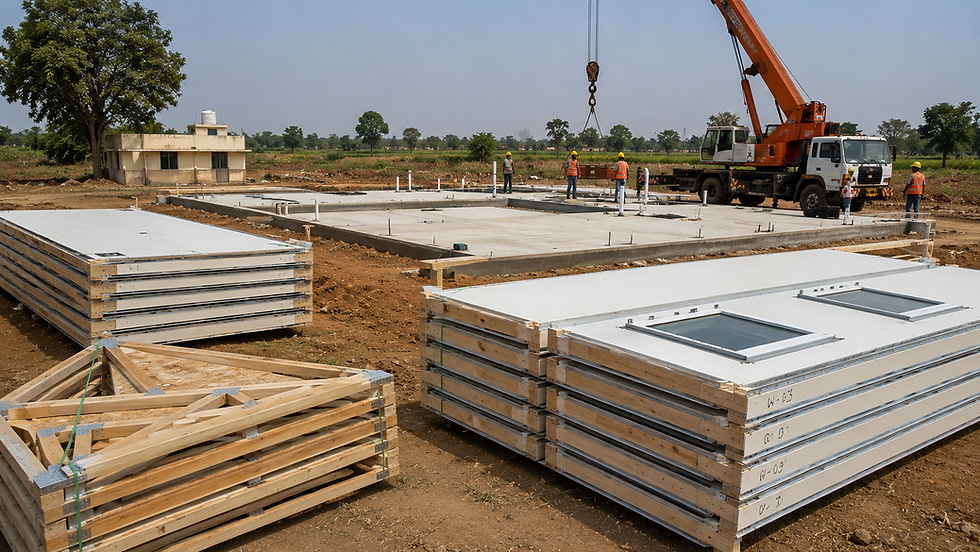
A foldable (or folding) home is a steel-framed unit — typically 19–40 ft long — whose walls and roof hinge flat for shipping, then unfold into a rigid box on site. Most units sold in India are imported, arrive as a single flat pack on a truck, and can be opened, bolted and sealed within a day. Standard versions include basic wiring, one or two partitioned rooms, and a small bathroom; everything sits on a prepared level base or simple pier foundation.
Foldable House Prices in India (2026)
Basic imported folding units (approx. 19–20 ft): ₹3–6 lakh landed, before site work
Larger / better-insulated folding units (30–40 ft): ₹6–12 lakh
The real, livable cost — after transport to site, crane charges, foundation base, plumbing and drainage connections, electrical hookup, awnings or roofing overlays for monsoon, and interior fit-out — typically lands at ₹8–18 lakh for a compact unit
For comparison, a purpose-built, fully insulated prefab studio from an Indian factory runs ₹8.5–30.5 lakh — see our complete price guide
The Honest Pros and Cons
Where foldable homes genuinely work
Speed — habitable in days once the base is ready; nothing else matches it
Site offices, security cabins and temporary staff accommodation — the format's natural home
Very tight budgets where a basic weather shell is the entire requirement
Relocatability — fold it back down and move it (with crane costs each time)
Where they struggle in Indian conditions
Thermal performance — thin sandwich-panel walls turn units into ovens at 45°C and iceboxes in hill winters; retrofitting insulation erodes the price advantage
Monsoon endurance — hinge lines and fold joints are permanent water-ingress risks; sealing needs annual attention, and many imported units are not engineered for 3–4 month Indian monsoons
Lifespan and warranty — imported units typically carry little or no meaningful Indian warranty; compare that with a 20-year structural and leakage warranty on factory-built prefab
Ceiling height, spans and aesthetics — you live inside a container geometry; families rarely stay happy in one beyond a season
Financing and resale — lenders and buyers treat them as equipment, not homes
Foldable Home vs Factory-Built Prefab: Which Should You Choose?
Choose a folding unit when you need a fast, temporary, movable shell — a site office, a caretaker cabin while your main home is built, or short-term worker housing. Choose factory-built prefab when you are creating an actual home or revenue asset: 100mm Rockwool-insulated walls, engineered LGSF structure with a 50+ year design life, Everest cement siding, 50-year-warranty shingle roofing, real bathrooms and full customisation — delivered in 45–90 days at ₹1,800–3,500 per sq ft. A folding box saves you weeks; a real prefab home earns rent, appreciates, and holds a 20-year warranty. Explore what purpose-built looks like in our holiday homes guide and glamping pods guide.
What is the price of a foldable house in India?
Basic imported 19–20 ft folding units cost ₹3–6 lakh landed; larger or better-insulated versions ₹6–12 lakh. The realistic all-in livable cost — foundation base, crane, utility connections, monsoon protection and interiors — is typically ₹8–18 lakh, which overlaps with purpose-built insulated prefab studios from Indian factories.
How long does a foldable home last in India?
Structure life varies widely with import quality, but the weak points are the fold joints and thin panels: expect ongoing sealing maintenance and a practical comfortable life of 5–15 years. Factory-built LGSF prefab homes, by comparison, carry 50+ year design lives and 20-year structural warranties.
Are foldable houses good for Indian summers and monsoons?
This is their biggest weakness. Thin sandwich panels perform poorly at 45°C without heavy air-conditioning, and hinge lines are permanent monsoon leak risks requiring regular resealing. If year-round comfort matters, insulated factory-built prefab is the stronger choice.
Do foldable homes need building approval in India?
Rules vary by state and land category, as with any structure. Small units on temporary bases may be treated as movable/temporary structures in some jurisdictions — verify with your local authority before purchase.
Is a foldable house better than a prefab house?
They solve different problems. Folding units win on speed and lowest entry price for temporary uses like site offices and cabins. Purpose-built prefab wins on insulation, monsoon engineering, lifespan, warranty, customisation, financing and resale — everything that matters for a real home or rental asset.
Can I use a foldable home as an Airbnb or farm stay?
Some hosts do, but guest reviews in Indian conditions tend to punish the thermal and acoustic comfort. Insulated prefab pods and cottages built for hospitality achieve higher nightly rates and better reviews — see our glamping pods guide for the economics.
Talk to India's Prefab Experts
Whether you choose a folding unit, a capsule pod or a full factory-built home, get expert guidance first. Loom Crafts has manufactured 600+ prefab homes and cottages across India since 2005, with ISO 9001:2015 certified processes and a 20-year structural warranty. Call / WhatsApp +91 84484 40556 | info@loomcrafts.com, or visit our experience centers in 15+ cities.
📅 Prefer a live walkthrough? Book a free online demo at a time that suits you — our team will take you through designs, 2026 pricing and the complete build process on a video call: Book Your Online Demo
📌 Add Loom Crafts Prefab as a Preferred Source on Google to see more of our guides in Top Stories and AI search.


Comments