
Building Luxury Resorts in Different Climates in India: The Complete Climate-Responsive Design Guide (2026)
Updated: Aug 26
Building Luxury Resorts in Different Climates in India: The Complete Climate-Responsive Design Guide (2026)
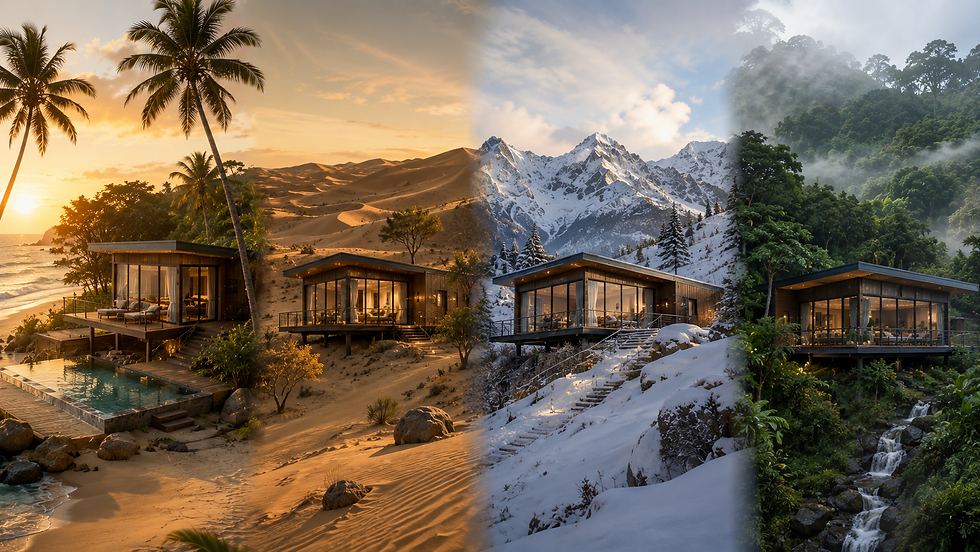
In This Guide You'll Learn:
Why climate-responsive design is the foundation of true resort luxury
Designing for hot-humid tropical climates - coasts, Kerala and the east
Designing for composite plains climates - the farmhouse and NCR belt
Designing for extreme-rainfall regions - Meghalaya and the Western Ghats
Universal luxury systems - envelope, comfort, acoustics and hot water
One factory, every climate - how prefab adapts to each region
Frequently asked questions about climate-responsive resort design
Planning a complete resort build? Start with our complete 2026 guide to prefab resort construction in India — cottage designs, per-key costs, ROI models and delivered projects.
Introduction
India is not one climate - it is nearly all of them. Within a single country, a resort developer can build beside a humid tropical sea in Goa, in the bone-dry heat of the Thar, on the temperate plains outside Delhi, at freezing altitude in Himachal, or under the heaviest rainfall on Earth in Meghalaya. Each of these environments will test a building differently, and each punishes designs copied thoughtlessly from somewhere else. The whitewashed Mediterranean villa that delights in Rajasthan grows mould streaks in Kerala; the glass-fronted mountain chalet that glows in Manali becomes a furnace in Jaisalmer.
This matters most at the luxury end of the market, because luxury, properly understood, is not marble and chandeliers - it is flawless comfort. The guest paying premium rates expects to be perfectly cool in the desert, perfectly warm in the snow, perfectly dry in the monsoon and perfectly untroubled by the machinery achieving it. Delivering that experience across India's climatic extremes is an engineering discipline: climate-responsive design.
This guide examines how luxury resort architecture, engineering and materials must adapt across India's five broad climate families - hot-humid, hot-dry, composite, cold and extreme-rainfall - and how modern factory-built construction delivers a climate-tuned building for each of them from a single engineering platform. Whether you are planning a beach villa cluster, a desert camp, a plains farmhouse resort or a Himalayan retreat, the principles here will shape a property that feels effortless to guests precisely because the hard thinking was done before the first foundation.
Loom Crafts Expert Insight: When we engineer cottages for different regions, the structure barely changes - galvanised steel frames carry loads the same way in Jaisalmer and Munsiyari. What changes is the envelope: insulation thickness, glazing specification, shading depth, ventilation paths, and the details where water, heat or dust try to enter. Developers sometimes ask for one standard cottage for projects in three climates. Our answer is one standard platform, three tuned envelopes - because the cottage that performs identically everywhere is performing optimally nowhere.
1. Why Climate-Responsive Design Defines True Luxury
Comfort Is the Product
Strip away the styling and every luxury resort sells the same core promise: within these walls, the environment is perfect. That promise costs radically different amounts to keep depending on how the building is designed. A poorly oriented, uninsulated structure keeps the promise only through brute-force air conditioning and heating - machinery that is expensive to run, noisy, prone to failure at the worst moment, and forever fighting the climate instead of working with it. A climate-responsive building keeps most of the promise passively - through orientation, shading, insulation, ventilation and material choice - and asks machinery only to finish the job. The difference shows up everywhere that matters: energy bills often cut dramatically, equipment lasting longer, silence in the rooms, and comfort that survives a power cut.
The Business Case
Energy is a top operating cost at most Indian resorts - passive design attacks it permanently, at design cost near zero
Guest reviews punish thermal failure above almost anything else - a hot room in May or a cold bathroom in January outweighs a hundred details done right
Climate-tuned buildings age gracefully - the mould, corrosion, cracking and fading that cheapen a property prematurely are almost always climate-mismatch symptoms
Insurance, maintenance and replacement cycles all lighten when the building suits its weather
Sustainability credentials - increasingly demanded by corporate bookers and international guests - flow naturally from a building that simply needs less
Reading a Climate Before Designing for It
Five questions decode any Indian site's climate brief: How hot does it get, and is the heat dry or humid? How cold do the coldest nights go? How much rain falls, how fast, and from which direction does the storm wind drive it? How large is the day-night temperature swing? And what does the air carry - salt, dust, moisture, or all three in sequence? The answers determine insulation levels, glazing specification, shading geometry, ventilation strategy and material selection. Everything else in this guide is the systematic application of those answers, climate family by climate family.
2. Hot-Humid Tropical Climates - Coasts, Kerala and the East
The Climate Brief
Goa, coastal Karnataka, Kerala, coastal Tamil Nadu, Bengal and the coastal North East share the tropical signature: temperatures rarely extreme but humidity relentless, monsoons heavy, and - on the coasts - salt in every breath of air. The enemy here is not heat alone but moisture: mould in wardrobes, swollen doors, damp bedding, corroded fittings and the sticky discomfort that no ceiling fan can defeat once humidity saturates a poorly designed room.
Design Responses for Luxury in the Tropics
Cross-ventilation as architecture - openings aligned to prevailing breezes so rooms flush themselves; the sea breeze is the first air conditioner
Deep roof overhangs and verandas - shading walls and glass from high-angle sun while sheltering openings so windows stay open in rain
Elevated floors - raising structures on plinths or stilts breaks ground damp, improves airflow and lifts living spaces into the breeze
Insulated, ventilated envelopes - Rockwool-insulated walls and roofs keep conditioned air in and radiant heat out, while ventilated cavities prevent condensation inside the assembly
Dehumidification-capable air conditioning - in the tropics, moisture removal is half the comfort equation; specify systems accordingly
Mould-resistant, corrosion-proof finishes - UPVC glazing, cement fiber cladding, marine-grade hardware and paints rated for humidity and salt
Outdoor living as the luxury - the deep furnished deck, the outdoor shower, the pavilion dinner: tropical luxury happens in shaded open air
For coastal projects specifically, the full corrosion discipline applies - galvanised structure, stainless fasteners, marine-rated fixtures - as detailed in our dedicated beach resort guide linked in the Continue Reading section.
3. Hot-Dry Desert Climates - Rajasthan and Kutch
The Climate Brief
Jaisalmer, Bikaner, Jodhpur's fringes, Pushkar's dunes and the Rann of Kutch deliver India's most theatrical luxury settings - and its harshest thermal mathematics. Summer days can exceed 45 degrees while winter desert nights approach freezing; the diurnal swing itself can span twenty degrees; sun is unrelenting, humidity negligible, and fine dust rides every wind. Yet the desert luxury market - palace-style resorts, dune camps, Rann tent cities - is among India's most celebrated, because the same extremity that challenges the engineer enchants the guest: impossible stars, golden light, silence with texture.
Design Responses for Desert Luxury
Insulation against heat, not just cold - thick Rockwool-insulated walls and roofs are the modern, lightweight answer to the traditional two-foot stone wall, blocking radiant gain by day and holding warmth on cold desert nights
Small, shaded, precisely placed glazing on sun-facing elevations, with generous openings reserved for the north light and the dune view at sunset
Courtyard and cluster planning - buildings shading each other, shaded internal courts with water features, and evening terraces oriented to the afterglow
Reflective, light-toned roofs and finishes that reject solar gain
Dust discipline - sealed junctions, filtered ventilation, entry vestibules and easily cleaned surfaces; dust is the desert's humidity
High-efficiency cooling sized for extreme peaks, backed by generous power backup - a desert luxury camp without cooling certainty in May is not a luxury camp
Night-sky programming built into the architecture - star decks, roofless bathing courts and telescope terraces monetise the desert's finest free asset
The Desert Camp Format
Rajasthan and Kutch have made the seasonal luxury camp a proven business: premium tented or light-structure suites operated through the winter season, commanding festival-period rates that rival metropolitan five-stars. Factory-built and demountable formats suit the model precisely - installed before the season, engineered for wind and thermal swing, and removable where land arrangements or regulations favour non-permanent structures.
4. Composite Plains Climates - The Farmhouse and NCR Belt
The Climate Brief
The great northern and central plains - the NCR farmhouse belt, Punjab, Haryana, Uttar Pradesh, Madhya Pradesh, Vidarbha - experience everything in sequence: fierce dry summer heat, a humid monsoon, and genuinely cold, foggy winters. This composite climate is the hardest to design for casually because no single-season strategy works; the building must pivot from rejecting heat to shedding rain to holding warmth within the same year. It is also, commercially, one of India's most important resort belts: wedding resorts, corporate retreat properties and weekend farm stays ringing every major plains city.
Design Responses for Composite Climates
The insulated envelope as the year-round answer - a well-insulated, well-sealed building moderates every season, cutting summer cooling and winter heating loads simultaneously
Double-glazed UPVC windows - the single upgrade that pays in all three seasons: heat out in June, warmth in through January fog, and silence always
Shading tuned to the sun's geometry - deep south-side overhangs that block high summer sun yet admit low winter sun onto terraces and glass
Reversible outdoor spaces - the lawn and pavilion culture of plains hospitality, designed with winter fire pits and summer misting so the outdoors works ten months a year
Monsoon-grade drainage and waterproofing - plains cloudbursts are brief but violent; flat-site drainage design prevents the annual waterlogged-lawn wedding disaster
Heating as standard, not afterthought - plains winters embarrass properties that pretend they do not happen; specify room heating and hot-water capacity for January, not October
Air-quality readiness in the NCR belt - filtered fresh-air provision has become a genuine luxury differentiator during winter smog episodes
The Wedding and Event Dimension
Plains resorts live disproportionately on weddings and corporate events, which changes the design brief: generous lawns with engineered drainage and power infrastructure, cottage clusters that can be block-booked, acoustic separation so events and resident guests coexist, and back-of-house logistics sized for two-hundred-guest catering. A climate-responsive plains property that also masters event infrastructure enjoys the strongest revenue mix in the category - weekend leisure, weekday corporate and season-long celebrations.
5. Cold Mountain Climates - The Himalayan Belt
The Climate Brief
From Himachal and Uttarakhand to Sikkim and Arunachal, the mountain brief inverts the plains: the enemy is cold, the asset is the view, and the two fight over the same wall. Winters bring freezing nights, snow load at altitude and frozen services; monsoons bring driving rain; and the luxury guest expects to sit in shirtsleeves behind a wall of glass while snow falls outside. Resolving that expectation is the whole art of mountain luxury engineering.
Design Responses for Cold-Climate Luxury
The warm envelope first - continuous Rockwool insulation in walls, roof and floor, sealed against air leakage; heating a leaky building at altitude is burning money to warm the sky
Double-glazed UPVC glazing sized generously - modern glazing lets the view stay huge without the heat loss that made old mountain hotels choose between windows and warmth
Steep, engineered roofs - shedding snow by geometry while carrying the design snow load, with eave details that prevent ice damming
Layered heating - efficient primary heating for the envelope, underfloor or panel warmth where budgets allow, and the fireplace or bukhari as the emotional hearth premium guests photograph
Freeze-protected services - water lines below frost depth or heat-traced, insulated tanks, and hot-water systems with cold-climate recovery rates
Solar gain harvested deliberately - south-facing glass and thermal-mass floors that bank the strong mountain sun into evening warmth
Seismic-appropriate light structure - much of the Himalaya sits in zones IV and V, where light, ductile steel framing is the responsible engineering choice
Slope engineering, foundations and the full mountain construction discipline are covered in depth in our dedicated hill resort guide, linked in the Continue Reading section below.
6. Extreme-Rainfall Regions - Meghalaya and the Western Ghats
The Climate Brief
Cherrapunji and Mawsynram receive the heaviest rainfall on the planet; the Western Ghats crest - Agumbe, Amboli, the Wayanad and Coorg highlands - is not far behind. In these regions rain is not a season but a governing force: months of it, wind-driven, finding every unsealed junction, saturating every unprotected material and testing every drainage assumption. Yet these are also among India's most spectacular emerging luxury destinations - living-root-bridge country, cloud forests, waterfall amphitheatres - where a property engineered for rain can sell the monsoon itself as the headline experience.
Design Responses for Extreme Rain
Roof as fortress - steep pitches, generous overhangs on every elevation, storm-rated profiled roofing, and flashing details treated as structural engineering rather than trim
Elevated everything - stilted structures, raised walkways and lifted service platforms keep buildings and guests above saturated ground for months at a time
Rainscreen cladding logic - ventilated cement fiber cladding assemblies that drain and dry, over sealed weather barriers, so walls shrug off horizontal rain
Drainage designed for cloudburst intensity - intercepts, lined channels, energy dissipation and generous safety factors; in these regions drainage is the master plan
Condensation-managed interiors - insulation plus cavity ventilation plus dehumidification capacity, so months of humidity never become mould
Covered circulation and covered outdoor rooms - the veranda deep enough to dine in a downpour is the region's defining luxury space
Materials that love water - UPVC, galvanised steel, treated composites and stone; nothing that swells, rusts unprotected or feeds fungus
Selling the Rain
Properties in extreme-rain country that engineer confidence can market the monsoon as their signature season: waterfall treks at full flow, cloud-watching decks, rain-sound sleep tourism, and photography packages in the most dramatic light India offers. The engineering is the marketing - only the building that laughs at the rain can invite guests to fall in love with it.
Landscape and Outdoor Design by Climate
The grounds must answer the climate as precisely as the buildings. Tropical properties landscape for shade and breeze - palms, broad canopies and water bodies that cool the air crossing them. Desert properties landscape for evening life - hardy native species, gravel gardens that never demand water the region lacks, and courts designed around the hour when the heat lifts and the property comes alive. Plains resorts landscape for events and seasons - lawn systems with subsurface drainage that survive both wedding marquees and monsoon weeks, deciduous shade that cools summers yet admits winter sun. Mountain properties terrace, windbreak and select for frost; extreme-rain properties choose species that love saturation and paths that never become streams. In every climate, quality all-weather outdoor furniture - a Loom Crafts speciality across both company verticals - determines whether the landscape is admired from windows or actually lived in, which is the difference between grounds as cost and grounds as revenue.
Tropical - shade trees, breeze corridors, water features as natural cooling
Desert - native xerophytic planting, evening-oriented courts, star-visibility lighting discipline
Plains - drained event lawns, deciduous summer shade admitting winter sun, fire-pit winters and misted summers
Mountain - terracing, windbreaks, frost-hardy species and slip-safe hard landscaping
Extreme rain - saturation-loving planting, engineered path drainage and covered outdoor rooms
7. Universal Luxury Systems - Envelope, Comfort, Acoustics and Hot Water
What Every Climate Shares
Beneath the regional tuning, four systems define perceived luxury in every Indian climate. First, the envelope: insulation, sealing and quality glazing are the foundation of comfort everywhere - the same Rockwool and double-glazed UPVC package that holds warmth in Manali holds cooling in Jaisalmer and hush in a rain-loud Coorg night. Second, conditioned comfort: right-sized, quietly installed heating and cooling with zoned control, because luxury guests expect their climate, not the property's compromise. Third, acoustics: the insulated envelope doubles as sound insulation, and luxury is measurably quieter - between rooms, from corridors, from machinery and from the wedding on the far lawn. Fourth, hot water certainty: pressure and temperature that never disappoint, engineered with recovery capacity for full-house mornings, because no amenity failure is reviewed more brutally than a cold shower at a premium rate.
The Quiet Machinery Standard
Equipment sized with headroom, so it cruises rather than strains - strain is noise and failure
Outdoor units and generators located and baffled away from every deck and window
Zoned controls in every unit - individual comfort is the definition of the category
Power backup that switches invisibly - the flicker is forgivable; the dead AC at 2 a.m. in May is not
Water treatment matched to source quality - hard-water scale quietly destroys fittings, finishes and guest hair-dryer opinions alike
Preventive maintenance calendars written at design stage - luxury is machinery that never becomes the guest's problem
Water Strategy by Climate
Water planning diverges by region as sharply as thermal design. Tropical and extreme-rain properties are drowning in supply for half the year and must harvest, store and manage it - oversized rainwater systems, first-flush handling and storage that carries the dry months. Desert properties face the opposite ledger: every litre trucked, drawn or recycled must be budgeted, which makes low-flow fixtures, treated-water reuse for landscape and honest guest communication about water culture part of the luxury proposition rather than a compromise of it. Plains properties balance borewell dependence against falling water tables and tightening extraction rules, arguing for harvesting and recharge as insurance. Mountain properties manage spring rights, freeze protection and storage head; coastal properties test for salinity intrusion seasonally. In every case, the STP-and-reuse loop converts the water problem into a landscape asset - and increasingly, into an approvals requirement.
Tropical and high-rain - harvest aggressively, store for the dry season, manage first-flush and overflow
Desert - budget every litre, reuse treated water, design landscape to the water reality
Plains - harvest and recharge against falling tables and tightening extraction norms
Mountain - secure spring rights, protect against freeze, exploit gravity storage
Coastal - monitor salinity seasonally and separate potable from utility supply
8. The Materials-by-Climate Specification Matrix
One Question, Five Answers
Ask of every material: what will this climate do to it in ten years? The answers organise cleanly. Structure: galvanised light gauge steel performs across all five climate families - the zinc coating answers coastal salt, the light ductile frame answers Himalayan seismic zones, and factory precision answers them all; it is the rare universal. Cladding: cement fiber board leads everywhere for its indifference to moisture, salt, insects and fire, with finish systems tuned by region - marine-rated coastal coatings, UV-heavy desert systems, ventilated rainscreen assemblies in extreme-rain zones. Glazing: UPVC frames in every climate - no corrosion at the coast, no warping in mountain damp, no thermal bridging in the desert - with double glazing standard in cold, composite and premium tropical applications. Insulation: Rockwool throughout, its thickness tuned upward for cold and desert extremes; inorganic and moisture-tolerant, it is the one insulation that thrives in tropical humidity. Roofing: engineered profiled systems with pitch and fastening tuned to the local threat - snow load in the mountains, cyclonic wind at the coast, cloudburst volume in the Ghats, dust-shedding simplicity in the desert.
Fittings and Finishes by Exposure
Coastal - marine-grade stainless hardware, Jaquar bathroom ranges suited to humidity, sealed exterior lighting rated for salt air
Desert - dust-sealed electrical fittings, scratch-tolerant matte finishes, deep-toned exteriors that hide the sand film between cleanings
Plains composite - the broadest palette, disciplined by monsoon-grade exterior sealing and winter-fog corrosion awareness
Mountain - frost-rated external fittings, timber-look finishes over stable substrates rather than reactive solid timber, slip-safe deck surfaces for frost mornings
Extreme rain - fungal-resistant everything, ventilated assemblies, and drainage detailing on every horizontal surface a designer draws
Loom Crafts Expert Insight: The specification matrix is where luxury projects are silently won or lost. Two resorts can open looking identical; five monsoons later, one has streaked walls, swollen doors and a maintenance budget in revolt, while the other still photographs like its launch campaign. The difference was never visible in the brochure - it was decided in material meetings years earlier. Our standard cottage specification exists precisely so that discipline is built in before anyone is tempted to negotiate with the climate.
Renovating Climate-Mismatched Properties
A growing share of enquiries in Indian hospitality is not for new builds but for rescues - properties five to fifteen years old whose climate mismatch has matured into streaked facades, mould cycles, energy bills and renovation quotes that rival reconstruction. The triage logic runs: fix the envelope before the interiors (insulation over-cladding, glazing replacement with double-glazed UPVC, roof and flashing renewal), because redecorating a thermally broken building repaints the symptom; phase works around operating seasons so revenue funds the cure; and where a structure is fundamentally wrong for its weather, factory-built replacement cottages installed in days often beat renovation on both cost and outcome - the old block retiring to staff or storage duty while new climate-tuned inventory takes the rate card upmarket. For buyers evaluating distressed resort assets, this calculus is the due diligence: price the envelope repair honestly, and many bargains stop being bargains - while some, with prefab replacement economics applied, become genuine ones.
9. One Factory, Every Climate - How Prefab Adapts to Each Region
The Platform-and-Tuning Model
Factory-built construction resolves the central paradox of multi-climate development: how to achieve engineered, repeatable quality while genuinely adapting to place. The galvanised steel structural platform remains constant - engineered per project for the governing local loads, whether cyclonic coastal wind, Himalayan snow and seismic demands, or desert thermal movement. Around that platform, the envelope is tuned in the factory: insulation thickness set by the thermal brief, glazing specification by the climate family, cladding and coating systems by the exposure, shading geometry by the sun path, and junction detailing by whatever the local weather weaponises - salt, dust, snow or horizontal rain. Every tuned decision is then executed under factory quality control rather than entrusted to whichever site crew a remote destination can muster.
Why This Beats Site-Built in Every Climate
Climate never interrupts manufacturing - cottages progress through monsoon, snow season and 45-degree summers alike, while conventional sites stand idle
Envelope quality is factory-verified - insulation continuity, sealing and flashing, the exact details climates exploit, are inspected on a production line rather than improvised on scaffolding
45 to 90 day delivery into any region - the desert camp opens for the festival season, the beach resort for winter, the hill property for summer
One warranty across the portfolio - a 20-year structural warranty and 50-year design life whether the address is Jaisalmer, Gokarna or Munsiyari
Multi-region developers gain a repeatable product - the brand's cottage, tuned per climate, delivered identically well everywhere the brand goes
Proof Across the Map
Loom Crafts has delivered factory-built cottages and villas across India's climate spectrum - coastal, mountain, plains, desert-edge and high-rainfall destinations - from the same Ghaziabad manufacturing platform, each project's envelope tuned to its region. That breadth is the practical demonstration of this guide's thesis: climates differ profoundly, but the discipline that answers them travels.
Multi-Region Portfolios: One Brand, Many Climates
For developers building beyond a single property, climate-responsive discipline becomes a portfolio strategy. Define the brand's guest experience - the bed, the bathroom standard, the deck ritual, the service marks - as invariants, and let each region's envelope achieve them by its own means. The factory-platform model makes this executable: the same engineered cottage line, climate-tuned per destination, delivers recognisable brand consistency from a Konkan clifftop to a Kumaon ridge without pretending the two places share weather. Portfolio developers also gain procurement leverage, faster per-project design cycles as the tuning library grows, and a repeatable approvals narrative - each new application arriving with the evidence of the last project's performance.
10. Costs, Planning and Climate Risk
What Climate Tuning Costs - and Saves
Climate-responsive specification is startlingly cheap at build time and startlingly expensive to retrofit. Upgrading insulation thickness, stepping to double glazing, specifying marine or desert-rated finishes and engineering proper shading typically adds only a modest percentage to cottage cost against the standard Loom Crafts range - studios from about Rs 8.5 lakh, 1BHK cottages from roughly Rs 11.85 lakh to Rs 28 lakh, 2BHK units from Rs 26.5 lakh to Rs 53.5 lakh and 3BHK villas upward of Rs 45.5 lakh, ex-GST. Against that premium sit permanent returns: cooling and heating loads cut sharply, equipment downsized and longer-lived, maintenance cycles stretched, and the slow-motion facade decay that forces premature renovation simply designed out. Across a ten-year horizon, the climate-tuned building is decisively the cheaper one - it merely pays its savings forward.
Planning for Climate Risk
Design to the extremes on record, not the averages in memory - the cloudburst, the heat spike and the freak snow week are the events that find weak buildings
Insure to the region's named perils - cyclone at the coast, flood beside rivers, storm and snow at altitude - with documented engineering that earns better terms
Build operational weather protocols - heat-day guest care, storm procedures, snow-clearing disciplines - into training from opening day
Track the climate trend line - hotter summers, wilder rain events and shifting seasons argue for specifying one notch above today's requirement
Phase with the seasons - schedule installation windows and openings so the climate works for your calendar, the core advantage 45 to 90 day factory delivery exists to exploit
A Note on Timelines
Climate shapes the construction calendar as surely as the building. The plains build around the monsoon, the mountains around winter, the coast around cyclone season and the desert around peak heat - which is precisely why compressing site exposure matters so much. With cottages manufactured off-site and installed in days, the weather-exposed portion of a project shrinks from a year of vulnerability to a foundations package and a short installation window, and the 8 to 11 month land-to-launch timelines described across this Stage 9 series hold in every climate family.
Frequently Asked Questions
1. What is climate-responsive design in resort construction?
It is the discipline of shaping a building's orientation, envelope, shading, ventilation, materials and systems around the specific climate it will live in - so comfort is achieved largely passively and machinery only finishes the job. In practice it means different insulation, glazing, shading and detailing for a Goa beach villa, a Jaisalmer desert suite and a Manali chalet, even when the underlying structure is the same.
2. Can the same cottage design work in different Indian climates?
The same platform can; the same envelope should not. A galvanised steel structural design adapts across regions, but insulation thickness, glazing specification, shading depth, cladding finish and junction detailing must be tuned per climate. Factory-built construction makes this practical - one engineered product line, tuned and quality-controlled per destination.
3. Which climate is hardest to build a luxury resort in?
Each has a defining challenge - salt at the coast, thermal extremes in the desert, everything-in-sequence on the plains, cold and logistics in the mountains, and relentless water in extreme-rain regions. The genuinely hardest project is the climate-mismatched one: a design imported from another region and asked to survive weather it was never engineered for.
4. How much extra does climate-tuned specification cost?
Typically a modest single-digit to low-teens percentage over base cottage cost, depending on climate severity - upgraded insulation, double glazing and exposure-rated finishes being the main items. It repays permanently through lower energy loads, longer equipment and finish life, and the avoided cost of premature renovation that climate-mismatched buildings inevitably face.
5. Do prefab cottages perform well in extreme heat and extreme cold?
Yes - performance follows the envelope, and factory-built envelopes are their strength. Rockwool-insulated walls and roofs with double-glazed UPVC openings hold conditioned comfort in 45-degree desert heat and sub-zero mountain nights alike, with insulation continuity and sealing executed under factory quality control rather than site improvisation.
6. How do I keep a coastal or high-rainfall resort free of mould and damp?
Through assembly design rather than cleaning schedules: insulated, ventilated wall and roof cavities that never trap moisture, elevated floors that break ground damp, dehumidification-capable air conditioning, and inorganic materials - Rockwool, cement fiber, UPVC - that give fungus nothing to eat. Buildings designed this way stay fresh through months of saturation.
7. What materials work in every Indian climate?
Galvanised light gauge steel structure, Rockwool insulation, cement fiber cladding and UPVC glazing form the rare universal core - each indifferent to moisture, salt, insects and thermal swing. Around that core, finishes, coatings, roofing profiles and hardware are selected per region's exposure.
8. Does climate-responsive design help with approvals and financing?
Increasingly, yes. Environmental authorities favour low-energy, regionally appropriate proposals; lenders favour defined specifications with manufacturer warranties over open-ended builds; and corporate and international bookers now screen for sustainability credentials that passive design delivers naturally. Good climate engineering has quietly become good paperwork.
Conclusion
India's climatic range is not an obstacle to luxury resort development - it is the design brief that makes Indian luxury distinctive. The desert camp, the tropical villa, the cloud-forest lodge and the snow-view chalet are each perfected by the same method: read the climate honestly, tune the envelope precisely, choose materials the weather cannot defeat, and let machinery whisper where design has already done the shouting. Do this and comfort becomes effortless, operating costs fall, buildings age like assets rather than liabilities, and the property keeps its founding promise at every temperature the country can produce.
Loom Crafts engineers that promise into factory-built form - one structural platform, five climate-tuned envelopes, delivered anywhere in India in 45 to 90 days with a 20-year structural warranty. Wherever your luxury resort is headed, we would be glad to help you design for what the sky there actually does.
📌 Add Loom Crafts Prefab as a Preferred Source on Google to see more of our guides in Top Stories and AI search.
Continue Reading
Developing a Resort - Stage 9: Location-Specific Resort Guides
Cross-Pillar Reading - Stage 8: Investment & Finance
Explore All Knowledge Center Pillars
Ready to Develop Your Luxury Resort?
Loom Crafts Prefab delivers climate-tuned luxury cottages and villas across every Indian region - one engineered galvanised steel platform, envelopes specified for coast, desert, plains, mountain and extreme-rain climates, 45 to 90 day delivery and a 20-year structural warranty. We support luxury resort developers with:
Climate-tuned specification - insulation, double-glazed UPVC, shading and exposure-rated finishes matched to your destination
Luxury formats - premium 1BHK to 4BHK villas, A-frames, studios, desert-camp and glamping units
Universal comfort systems - acoustic-grade envelopes, HVAC-ready design and hot-water certainty engineered in
Resort Development Services - master planning support, room-mix guidance and multi-region rollout planning
Transparent pricing and pan-India delivery to every climate zone
Call Our Resort Team: +91 98711 22239 (Rahul Jindal) | Email: rahul@loomcrafts.com
📅 Prefer a live walkthrough? Book a free online demo at a time that suits you — our team will take you through designs, 2026 pricing and the complete build process on a video call: Book Your Online Demo
Important Disclaimer
This article is provided for general educational purposes only. Climate data, design guidance, costs, rates and timelines described here are indicative, vary by site and region, and change over time. This content does not constitute engineering, legal, financial or investment advice. Always obtain site-specific climate and structural engineering assessments, verify applicable building regulations for your location, and engage qualified architects, structural engineers, chartered accountants and legal counsel before commencing any resort development project.


Comments