
Resort Operations & Facility Management: The Complete Guide for Indian Resort Owners (2026)
Updated: Aug 26
Resort Operations & Facility Management: The Complete Guide for Indian Resort Owners (2026)
In This Guide You'll Learn:
Why operational systems determine long-term resort profitability
Housekeeping systems — the daily standard that guests experience most
Maintenance planning — preventing the problems that generate bad reviews
Technology for resort operations — PMS, OTA and communication tools
Back-of-house planning — the operational spaces guests never see
Operational workflows — the daily, weekly and seasonal rhythms of resort management
Planning a complete resort build? Start with our complete 2026 guide to prefab resort construction in India — cottage designs, per-key costs, ROI models and delivered projects.
Introduction
A resort can be beautifully designed, expertly built and furnished with exceptional furniture — and still fail commercially if its operations are poor. Inconsistent housekeeping, a maintenance team that reacts rather than prevents, a kitchen that cannot sustain quality under occupancy pressure, a front-of-house team that is warm on good days and indifferent on bad ones — these operational failures appear in reviews with a specificity and frequency that erodes booking confidence and ADR sustainability over time.
Resort operations are the systems, the teams and the daily rhythms that translate the physical investment in buildings, furniture and landscape into the consistent guest experience that generates five-star reviews. This guide covers the complete operational framework for an Indian boutique resort of 8 to 15 cottages — the scale at which most first-time resort developers are operating.
Loom Crafts Expert Insight: In our experience delivering resort projects across India — from a 6-cottage riverside retreat in Rishikesh to a 14-cottage luxury glamping property near Bangalore — the resorts that sustain high occupancy and premium ADRs 3 to 5 years after opening are invariably those where the owner or a trusted senior manager is present at the property for a significant portion of the year. The boutique resort business is fundamentally a personal hospitality business. Systems and staff can deliver consistency; the owner's presence delivers character. The most-reviewed positive phrase across boutique Indian resort reviews in 2025 is 'the host was wonderful' — not 'the cottage was beautiful'.
1. Staffing — The Right Team Structure
Core Team for a 10 to 15 Cottage Boutique Resort
Resort Manager (1): The senior operational leader responsible for the overall guest experience, staff management, vendor relationships and daily operations. Should have prior hospitality management experience — ideally in boutique resort or boutique hotel operations. This person is the most important hire the resort developer makes.
Front Desk / Guest Relations (1 to 2): The primary point of guest contact for check-in, check-out, activity booking, food and beverage orders and guest enquiries. Must have excellent communication skills in English and Hindi (plus the local language for the resort's destination).
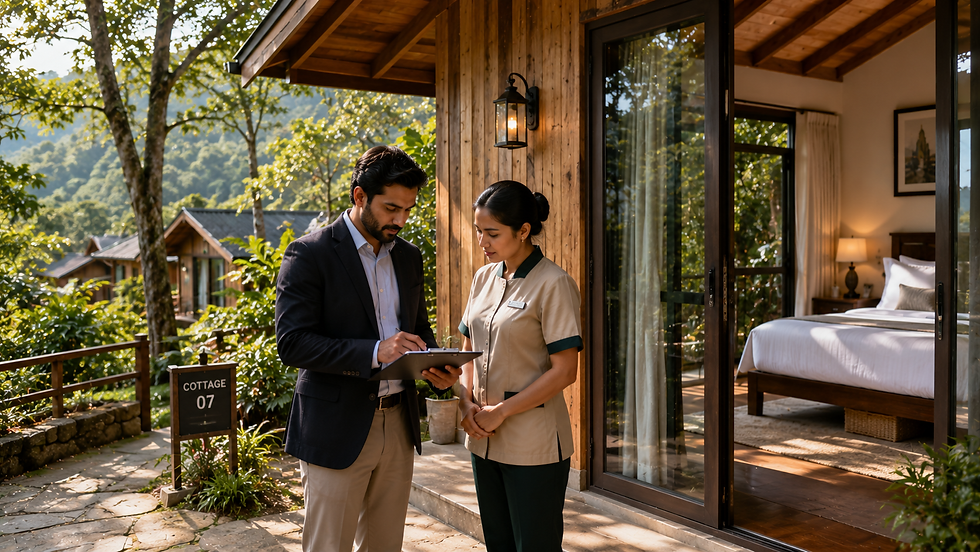
Housekeeping Team (3 to 5): One housekeeper per 3 to 4 cottages is the standard ratio for boutique resort operations — allowing each cottage to be serviced within a 2-hour window after checkout. Senior housekeeper responsible for quality inspection of all serviced cottages.
Kitchen Team (2 to 4): Chef and kitchen assistants scaled to the food and beverage volume. For a 10 to 15 cottage resort offering breakfast, lunch and dinner, a minimum of 1 experienced chef plus 2 kitchen assistants is required for sustained quality.
Maintenance Technician (1): A multi-skilled maintenance person capable of first-line electrical, plumbing and general maintenance across all buildings, equipment and landscape infrastructure. This role prevents the majority of maintenance-related guest experience failures.
Grounds and Landscaping (1 to 2): Responsible for daily grounds maintenance — pathway cleaning, plant watering, pool maintenance, outdoor furniture cleaning and placement. The appearance of the grounds is the first thing a guest sees every morning.
Security (1 to 2 per shift): For remote resort locations, a security presence at the site entrance and perimeter is both a safety requirement and a guest reassurance.
Staff Training Priorities
Guest interaction: Every staff member who has contact with guests must be trained in warm, confident, unhurried guest interaction — using the guest's name, maintaining eye contact, offering assistance proactively. This is a culture that must be modelled by the manager and consistently reinforced.
Problem resolution: Train every guest-facing team member with a clear protocol for resolving guest problems — listen fully, apologise genuinely, resolve immediately, follow up. A problem that is resolved well generates stronger loyalty than no problem at all.
Housekeeping standards: Detailed room inspection checklists, linen handling procedures, product replenishment standards and reporting protocols for maintenance issues discovered during room service.
Food safety and hygiene: FSSAI compliance for all kitchen team members, food storage and temperature protocols, allergen awareness.
2. Housekeeping Systems
Housekeeping quality is the operational standard that guests experience most directly and most frequently — the daily interaction with the team that maintains the cottage is invisible when done perfectly and immediately apparent when done poorly. A missed surface, a depleted amenity not replenished, a towel folded carelessly, a floor with a visible dirt line at the skirting board — these signal operational standards inconsistent with the ADR and the aspirations of the brand.
Cottage Servicing Standard — Checkout Day
Full linen change — all bed linen, pillow covers, towels, bath mats removed and replaced
Full bathroom clean — WC, basin, shower, bath, mirror, floor, all surfaces
Full cottage vacuum or mop — all floor areas including under furniture
Dust all surfaces — furniture, light fittings, windowsills, artwork frames, ceiling fans
Replenish all amenities — toiletries, water, tea and coffee, minibar items
Check and test all electrical equipment — AC, TV, kettle, hairdryer
Report any maintenance issues — dripping taps, sticky doors, damaged furniture — on the housekeeping maintenance log
Final inspection by senior housekeeper — using the room inspection checklist before marking the cottage as ready
Cottage Servicing Standard — Stay-Over Day
Tidy all surfaces — replace items disturbed by the guest in appropriate positions
Replace used towels only if requested by the guest (towel on floor = replace; towel on rail = retain)
Replenish amenities used
Empty rubbish bins
Check and note any maintenance issues
Do not move or rearrange the guest's personal belongings
3. Maintenance Planning
Reactive maintenance — fixing things after they fail — is more expensive, more disruptive and more damaging to the guest experience than planned preventive maintenance. A maintenance system that identifies and addresses potential failures before they become guest-visible problems is one of the highest-return operational investments available to a resort developer.
Daily Maintenance Checks
Pool water chemistry check and adjustment — chlorine, pH, total dissolved solids
Generator fuel level and battery condition check
All pathway and exterior lighting operational check
Grounds inspection — fallen branches, drainage blockages, damaged pathway surfaces
Review of maintenance requests logged by housekeeping from previous day's room servicing
Weekly Maintenance Activities
AC filter cleaning — all cottage and common area units
Water tank level check and pump system inspection
STP operational check — inlet flow, aeration system, effluent quality visual check
External cladding and roofline visual inspection for any damage or debris accumulation
Outdoor furniture inspection — cushion condition, frame integrity, any rust or damage
Seasonal Maintenance — Pre-Monsoon
Comprehensive inspection and re-sealing of all external joints — window perimeters, wall-to-roof flashings, cladding panel joints
Gutter and downpipe cleaning and flow testing
Pool cover installation or pool chemistry adjustment for reduced use period
Generator load test and fuel stock replenishment
All drainage channels and soakaway points cleared
4. Landscaping and Grounds Management
Daily pathway and common area cleaning: Sweep or blow all hard surface pathways, pool deck and terrace areas every morning before guests are likely to be active.
Plant maintenance: Water all planted areas according to seasonal requirements; prune overgrown plants that encroach on pathways or cottage sightlines; replace plants that fail or are damaged.
Lawn maintenance: Mow and edge all lawn areas weekly during the growing season; treat for moss and weed growth; irrigate during dry periods.
Outdoor furniture placement: Every morning, reset all outdoor furniture to its correct position — terrace sets, pool loungers, dining area chairs — ensuring everything is clean, cushions are in place and the resort looks prepared for the arriving day.
Pest control: Schedule professional pest control treatment quarterly for all buildings and grounds; maintain a rat and snake exclusion programme for forest and rural resort locations.
5. Security Systems
Perimeter security: A clearly defined and maintained resort perimeter — fencing, hedging or natural boundary — with a controlled access point at the main entrance. A security barrier at the entrance with a staffed or CCTV-monitored arrival protocol prevents unauthorised vehicle access.
CCTV coverage: External CCTV cameras covering the entrance, car park, reception approach and common area perimeter. Camera coverage is both a deterrent and an incident investigation resource. Guest privacy must be protected — no cameras within cottage boundaries or at cottage entrances.
Night security: A trained security guard present on site during night hours (10pm to 6am minimum) for any resort in a remote location or with wildlife proximity.
Fire safety: Functional fire extinguishers in every cottage (1 per kitchen area and 1 general extinguisher), clearly marked escape routes, fire alarm system in the reception and kitchen building, staff trained in fire extinguisher use and evacuation procedures.
Emergency protocols: A clear written protocol for medical emergencies, fire, flood and security incidents — including the contact numbers for the nearest hospital, fire station, police station and ambulance service, posted in a visible location in every cottage and at the reception.
6. Technology for Resort Operations
Property Management System (PMS)
A cloud-based PMS is the operational backbone of a professionally run resort — managing bookings from all channels (OTA, direct, phone), generating occupancy and revenue reports, tracking guest history, managing room inventory and processing payments. For an Indian boutique resort of 8 to 15 cottages, appropriate PMS options include Hotelogix, eZee, RMS Cloud and Little Hotelier — all offering OTA channel manager integration and cloud-based access for Rs 3,000 to Rs 8,000 per month.
OTA Channel Manager
A channel manager connects the resort's availability calendar in real-time to all OTA platforms — Airbnb, MakeMyTrip, Booking.com, Goibibo, VRBO — preventing double bookings and ensuring that rate changes are reflected across all platforms simultaneously. Managing OTA calendars manually without a channel manager is a significant operational risk for any resort taking bookings from more than 2 platforms.
Guest Communication Tools
Pre-arrival: Automated WhatsApp or email sequence triggered by booking confirmation — sending directions, arrival time confirmation and pre-arrival questionnaire
On-property: A simple digital property guide accessible via QR code, covering WiFi password, dining times, activity options, check-out procedures and emergency contacts
Post-stay: Automated review request sequence sent 24 to 48 hours after checkout on platforms where the guest booked
7. Back-of-House Planning
The back-of-house areas of a resort — the kitchen, the laundry, the maintenance workshop, the staff accommodation, the storage areas — are invisible to guests but directly determine the operational effectiveness of every guest-facing activity. Under-investing in back-of-house space and infrastructure is one of the most common design errors in first-time resort development.
Kitchen: Sized for the peak cover count with adequate equipment — commercial refrigeration, adequate cooking surfaces, proper ventilation and fire suppression. A kitchen that is too small for peak occupancy creates service delays and quality inconsistency that guests experience directly.
Laundry: A commercial laundry room with industrial washing machines and tumble dryers adequate to process all resort linen within a single daily cycle. For a 12-cottage resort with daily checkout servicing, a minimum of 2 commercial washing machines (12kg capacity each) and 2 tumble dryers is required.
Staff accommodation: For resorts in remote locations, on-site staff accommodation for the core operations team is essential — staff who commute long distances arrive tired and leave early, consistently reducing service quality during morning and evening peak periods.
Storage: Adequate dry storage for amenity products, cleaning supplies, spare linen, maintenance materials and outdoor furniture cushions during monsoon season. Storage space is consistently underplanned in resort design; allocate a minimum of 15 to 20 sq m of enclosed dry storage for a 10-cottage resort.
8. Operational Workflows
Daily Operations Rhythm
5:30am: Kitchen open, breakfast preparation begins
6:00am: Grounds team active — pathway cleaning, outdoor furniture reset, pool check
7:00am: Breakfast service begins
9:00am: Housekeeping team begins checkout cottage servicing
10:00am: Check-out time; departing guests settled and farewelled
12:00pm: All checkout cottages serviced and inspected; ready for same-day arrivals
2:00pm: Check-in begins; arriving guests welcomed and oriented
6:00pm: Evening shift begins — ambient lighting activated, common areas prepared for evening use
7:00pm: Dinner service begins
10:00pm: Night security shift begins; non-essential lighting reduced
Frequently Asked Questions
1. How many staff does a 10-cottage boutique resort need?
A 10-cottage boutique resort at 70 percent annual occupancy typically requires 12 to 18 full-time equivalent staff: 1 resort manager; 1 to 2 front desk; 3 to 4 housekeeping; 2 to 3 kitchen; 1 maintenance; 1 to 2 grounds; 2 security (covering two shifts). Additional part-time or seasonal staff for peak occupancy periods.
2. What is the most important technology investment for a new boutique resort?
A cloud-based Property Management System with integrated OTA channel manager. This single technology investment — typically Rs 3,000 to Rs 8,000 per month — prevents double bookings, provides real-time revenue visibility, enables professional rate management and creates the guest history database that supports personalised service.
3. How do I manage a remote resort property when I cannot always be on-site?
Appoint a highly trusted, experienced Resort Manager as your on-site operational leader. Establish clear reporting rhythms — daily occupancy and revenue summary; weekly maintenance and operational report; monthly financial summary. Install CCTV at key operational positions accessible via your phone. Conduct on-site visits at minimum monthly during the first year of operation to build culture and standards.
4. What is the most common operational failure in new Indian boutique resorts?
Kitchen quality inconsistency under occupancy pressure. A kitchen that performs excellently at 40 percent occupancy with experienced staff often deteriorates significantly at 80 percent occupancy or when a key team member is absent. Invest in kitchen team depth (always have a trained second cook who can substitute for the head chef); standardise recipes so quality does not depend on a single individual; and manage the food and beverage offering to match the kitchen's reliable capacity rather than its theoretical maximum.
Conclusion
Resort operations are the daily, weekly and seasonal systems that translate the physical investment in buildings, landscape and furniture into the consistent guest experience that generates commercial success. The most beautiful resort in India will fail commercially with poor operations; a modestly beautiful resort with exceptional operations will sustain high occupancy and premium ADRs year after year. Invest in operations as seriously as in construction — hire a great Resort Manager before you open; build the systems before you need them; and be present enough that the culture reflects your standards, not just your intentions.
📌 Add Loom Crafts Prefab as a Preferred Source on Google to see more of our guides in Top Stories and AI search.
Continue Reading
Developing a Resort — Stage 7: Resort Operations & Guest Experience
Explore All Knowledge Center Pillars
Ready to Create an Exceptional Resort Experience?
Loom Crafts Prefab designs and builds resort cottages engineered for exceptional guest experiences — 600+ structures delivered across 50+ resort locations in India. Our LGSF construction system, Rockwool insulation and Loom Crafts outdoor furniture work together to create resorts that guests remember and return to.
Call Our Resort Team: +91 98711 22239 (Rahul Jindal) | Email: rahul@loomcrafts.com
📅 Prefer a live walkthrough? Book a free online demo at a time that suits you — our team will take you through designs, 2026 pricing and the complete build process on a video call: Book Your Online Demo
Important Disclaimer
Operational guidance and cost references in this article are illustrative and for general educational purposes only. Engage qualified hospitality consultants for resort-specific operational planning.


Comments