
Creating an Instagrammable Resort: Design for Social Media, Guest Engagement & Brand Identity (2026)
Updated: Aug 26
Creating an Instagrammable Resort: Design for Social Media, Guest Engagement & Brand Identity (2026)
In This Guide You'll Learn:
Why social media shareability is now a commercial imperative for boutique resorts
The relationship between authentic design and social media performance
Designing signature photo spots that guests actively seek out
Signature architecture — creating forms that are unmistakably yours
Colour and light — designing for the camera without designing for the camera
Guest engagement — creating moments that drive organic sharing
Frequently asked questions about creating an Instagrammable resort
Planning a complete resort build? Start with our complete 2026 guide to prefab resort construction in India — cottage designs, per-key costs, ROI models and delivered projects.
Introduction
The word Instagrammable has become shorthand for a quality of resort design that is commercially significant and empirically measurable. Properties whose designs generate high rates of organic social media sharing consistently attract more bookings from aspirational discovery — the moment a potential guest encounters a compelling photograph on Instagram or Pinterest, saves it, researches the property and eventually books. This discovery mechanism is now one of the primary booking drivers for boutique resorts in India, particularly for the 25 to 45 year old demographic that drives premium leisure travel growth.
Understanding what makes resort design socially shareable — and building that understanding into design decisions at every scale from the master plan to the bathroom fitting — is now a commercial imperative rather than a marketing afterthought. This does not mean designing resorts to look good in photographs at the expense of the guest experience. The resorts that generate the most organic sharing are almost always those where genuine design excellence and authentic sense of place create moments that guests feel compelled to capture and share.
💡 Loom Crafts Expert Insight: The most photographed resort element in India is almost always the one that least expects it — not the signature swimming pool or the architecturally ambitious reception, but the reading hammock at the perfect angle with the forest behind it, the morning coffee tray on the cottage railing with mist in the valley below, the fire pit with a couple silhouetted against the dark forest. Design for these moments by providing the conditions — the view, the light angle, the comfortable perch — not by building elaborate staging. Authenticity is more photographable than performance.
1. Authentic Design and Social Media Performance
The most socially shared resort content is not staged for photography — it is captured because a guest was genuinely moved by a moment they did not anticipate. The difference between a resort that guests photograph and a resort they share is authenticity: the sense that what they are capturing is real, specific to this place and irreproducible elsewhere.
Designing for Authentic Moments
Light: Position outdoor seating to catch the golden hour light from the optimal angle — guests photograph the light, not the furniture
View: Ensure at least three specific positions on the resort offer views that are genuinely extraordinary and specific to this location
Privacy: Create conditions for intimate moments — a cottage terrace where guests feel entirely alone, a garden alcove with enclosing planting, a pool at a time when it is empty
Surprise: Plan moments of unexpected beauty that guests discover rather than seek — a specific tree that flowers spectacularly in March, a firefly swarm visible from the terrace, a particular bend in the nature trail where the valley suddenly opens
2. Designing Signature Photo Spots
A signature photo spot is a specific, designed position from which a particular photograph is possible — one so compelling it becomes the primary image associated with the resort's social media presence. Every successful boutique resort in India has one.
Characteristics of a Great Signature Photo Spot
Unique to the specific resort — captures something that could not be photographed anywhere else
Immediately compelling — creates a strong visual response before the viewer has time to think about it
Reproducible by any guest with a smartphone — does not require professional equipment or skill
Associated with a specific emotion or experience — not just visually beautiful but narratively rich
Available at multiple times of day — morning, golden hour and evening versions create different moods
Types of Signature Photo Spots
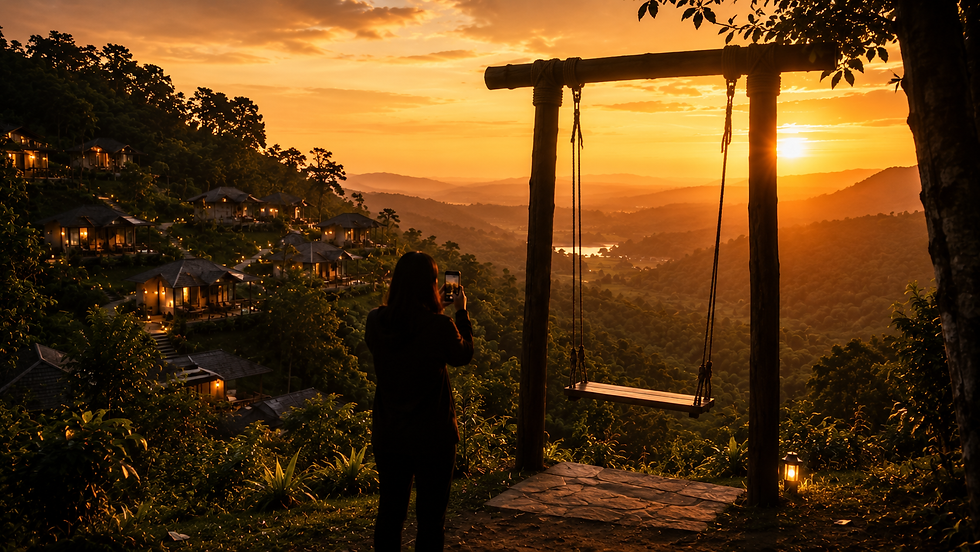
The Swing Shot: A swing chair, hanging bed or hammock positioned at a viewpoint with the landscape behind. One of India's most shared resort photograph types. Requirements: attractive swing design, a background that recedes naturally into a landscape view, golden hour light from the optimal angle.
The Infinity Reflection: An infinity pool positioned so the water appears to merge with the sky or landscape beyond. Requirements: a pool edge that disappears visually, a compelling horizon, afternoon light that creates sky reflections.
The Cottage Terrace Frame: The view from a specific cottage terrace that combines foreground elements (morning coffee, wildflowers, a book) with a middle-distance landscape and sky. Most powerful at golden hour or sunrise.
The Pathway Discovery: A turn in a resort pathway where a particularly beautiful view or garden feature is suddenly revealed.
The Bath or Shower Moment: An outdoor shower or bathtub positioned with a compelling view — consistently among the most shared resort bathroom photographs.
Planning Signature Spots Into the Design
Identify potential signature photo spots during the site analysis phase — before any design decisions. Stand at natural viewpoints on the site and ask: what is the most compelling thing I can see from here, and what designed element would create conditions for a guest to photograph it naturally? Then design the master plan to create and protect access to these spots.
3. Signature Architecture — Unmistakably Yours
Creating Architectural Distinctiveness
One bold architectural decision: A single distinctive design element — an unusual roof form, a dramatic cantilevered viewing deck, a facade material specific to the region — is more effective as a brand identifier than a generically refined design language
Consistent material palette: Two or three distinctive materials used consistently throughout the resort create a visual coherence immediately recognisable in photographs
Distinctive colour: A specific colour that is unusual but resonant — a deep terracotta reflecting the clay soil of the region, a specific green echoing the surrounding forest — becomes the resort's visual signature
Unique structural element: A specific structural form that appears in multiple locations throughout the resort creates a design motif that guests photograph and associate with the property
Architecture and the Resort Brand
The most successful resort brand identities in India are those where the architecture is the brand — where you can identify the property immediately from a photograph without seeing the name. Achieving this requires: a strong, specific design concept expressed consistently at every scale; willingness to commit to unconventional design choices rather than defaulting to generic luxury aesthetics; and a designer who understands the specific landscape and cultural context of the location.
4. Colour and Light
Colour Palette for Photography
Warm, earthy tones (terracotta, ochre, warm white, honey, sage green) photograph beautifully in golden hour light — the warm tones of the architecture and the warm tones of the light reinforce each other
High contrast between architectural surfaces and the landscape background — a white cottage against a dark green forest is dramatically more photogenic than a dark cottage against a dark forest
Textures that photograph well at close range — rough lime plaster, woven natural materials, textured stone — create visual interest in detail photographs
Avoid cool greys, pure whites with blue undertones and aggressively saturated colours — these photograph poorly in natural light and create visual disconnection from the natural environment
Designing for Golden Hour
The golden hour — 30 minutes before and after sunrise and sunset — is when the most compelling resort photographs are taken. Design the resort's key photographic positions — signature spots, dining terraces, pool decks, cottage terraces — to receive golden hour light from the optimal angle for photography.
5. The Instagram Hierarchy of Resort Spaces
Most Photographed Resort Spaces in India
1st: Infinity pool or special pool with landscape view — the single most shared resort photograph type
2nd: Cottage terrace or balcony with landscape view — particularly at golden hour with coffee, books or breakfast
3rd: The swing, hammock or hanging chair at a viewpoint
4th: The outdoor shower or bathtub with a garden or sky view
5th: The resort entrance or arrival moment — the driveway reveal, the reception pavilion
6th: The fire pit gathering moment at night with warm firelight
7th: The dining experience — particularly private outdoor dining with candles and landscape
8th: The bedroom interior — specifically the bed with the window view as a composition
9th: The yoga or wellness space — an open-sided shala with nature visible
10th: The nature experience — birdwatching, forest walk, wildlife sighting
This hierarchy suggests clear design investment priorities. The infinity pool and cottage terrace — ranked first and second — should receive a disproportionate share of the design budget and attention. The swing and outdoor shower — ranked third and fourth — require relatively modest investment but generate outsized social media return.
6. Visual Storytelling Through the Guest Journey
Design the resort to deliver compelling visual moments at each stage of the guest narrative:
Arrival: The driveway approach that reveals the resort progressively — a turn, a viewpoint, a first glimpse of the architecture through the planting
Check-in: The reception moment — the welcome drink, the view from the reception pavilion, the first impression of the landscape
First evening: The sunset at the viewpoint, the fire pit moment, the dinner terrace at golden hour
Morning: The sunrise from the cottage terrace, the morning coffee with the valley view, the dew on the planting
Daytime: The pool at midday, the nature trail discovery, the yoga at the shala, the cooking class in the kitchen garden
Final evening: The private dinner, the stars from the terrace, the fire pit farewell
The Departure Moment
The departure is the final chapter of the guest's story and determines whether the post-stay emotional response motivates an immediate review. A departure ceremony — a small gift of local produce, a handwritten farewell note, a final photograph at the signature spot — creates the emotional peak that motivates review writing and social sharing from the departing guest.
7. Guest Engagement — Creating Moments That Drive Organic Sharing
The Surprise and Delight Protocol
The most shared resort moments are frequently those guests did not expect: the chilled bottle of local wine in the cottage minibar on arrival, the firefly display visible from the terrace on the second night, the bird guide delivered to the cottage with morning coffee, the personalised picnic that appeared at the viewpoint on the third afternoon. These moments are not expensive to create — they require attention, creativity and the operational discipline to deliver them consistently.
Seasonal and Ephemeral Experiences
Experiences specific to a season or moment — the coffee blossom flowering in Coorg, the flamingo migration at the coastal resort, the apple harvest at the Himachal property, the firefly season in the forest — create the urgency and exclusivity that motivate both booking and sharing. Identify the seasonal highlights of your specific location and design programming around them.
8. Building Your Resort's Brand Identity
Visual Identity Elements
Name: Specific and evocative — ideally referencing the landscape, the culture or the specific character of the location
Logo: Simple, distinctive, appropriate to the positioning — not generic hotel iconography but something that captures the specific identity of the property
Colour palette: Two or three colours appearing consistently across all resort communications — website, printed materials, social media, signage, staff uniforms
Photography style: A consistent photographic approach — film simulation, colour grading, composition style — that makes all resort photographs immediately recognisable as belonging to this property
Brand Expression Through Design
The brand identity must be expressed through the physical design of the resort — not just through logos and marketing materials. A brand positioning around ecological sensitivity must express this through visible sustainability credentials in design and operations. A brand positioning around luxury privacy must express this through genuinely generous spacing between cottages and genuinely private cottage terraces. The brand promise must be delivered by the physical reality.
9. Social Media Content Strategy
Content Pillars for Resort Social Media
Nature and landscape: The natural beauty of the resort's setting — sunrise photographs, seasonal flowering, wildlife sightings — content that could only come from this specific place
Guest experience moments: The arrival, the outdoor dining, the pool moment, the fire pit — experiential content communicating what it feels like to stay
Food and beverage: The farm-to-table story, the signature cocktail, the breakfast at the viewpoint — content communicating F&B quality and philosophy
Behind the scenes: The kitchen garden preparation, the staff member hand-picking flowers for arrivals, the chef's market visit — content communicating the care behind the guest experience
Seasonal and ephemeral: The monsoon mist, the coffee blossom, the wildflower that appears in March — content creating urgency and exclusivity
Leveraging Guest-Generated Content
The most effective resort social media content is created by guests. Encourage guest content generation through: a dedicated hashtag prominently displayed in the resort; a signature spot that makes the best content location obvious; a photo-sharing incentive; and a post-stay message that features their best photographs on the resort's own account.
Platform Strategy
Instagram: Primary platform for Indian boutique resort marketing. Post 3 to 5 times per week. Reels of 30 to 60 seconds outperform static posts by 3 to 5 times in reach.
Google Business Profile: Update with current photographs monthly — highly significant for search visibility and direct booking conversion
Pinterest: Underused by Indian resorts but highly effective for aspirational discovery — long-duration image saves that convert to bookings over months
YouTube: Long-form property tour videos of 8 to 15 minutes convert extremely well for guests in the consideration phase comparing your resort with alternatives
Frequently Asked Questions
1. Do I need a professional photographer before opening?
Yes — professional photography before opening is one of the highest-return pre-opening investments. Platform algorithms rank properties with higher-quality photographs more prominently. Budget Rs 50,000 to Rs 1.5 lakh for a comprehensive professional shoot before opening.
2. How many signature photo spots should a boutique resort have?
One primary signature spot — the photograph most closely associated with the resort — and three to five secondary spots that offer different compositions, light conditions and experiential contexts.
3. Should I design for social media at the expense of guest experience?
No — and the most successful Instagrammable resorts demonstrate that this trade-off is a false one. Genuine design excellence, authentic sense of place and extraordinary natural moments create both the best guest experiences and the most compelling social media content. Design for the guest experience first; social media performance follows from authentic quality.
4. How important is Instagram relative to other marketing channels for Indian boutique resorts?
Extremely important for the 25 to 45 year old urban Indian leisure traveller that drives boutique resort demand growth. Instagram and social media discovery is the primary channel for first awareness of new boutique properties in this segment.
Conclusion
Creating a resort that guests want to photograph and share is not about manufacturing Instagrammable moments through staging or visual tricks. It is about designing a property with such genuine quality, such authentic connection to its specific place and such thoughtful attention to the conditions that create beautiful human moments that guests feel compelled to capture and share those moments with everyone they know.
The design decisions in this article — the signature photo spots, the distinctive architecture, the quality of light and colour, the visual storytelling of the guest journey, the moments of surprise and delight — are not marketing tactics. They are design excellence expressed through the contemporary language of visual communication. Build an extraordinary resort, in an extraordinary location, with extraordinary attention to the conditions that create extraordinary moments — and the social media performance will take care of itself.
This completes Stage 4 of the Developing a Resort Knowledge Center — Design and Guest Experience. Stage 5 covers Buildings, Engineering and Materials: the structural and material decisions that determine how well your resort performs physically over decades.
📌 Add Loom Crafts Prefab as a Preferred Source on Google to see more of our guides in Top Stories and AI search.
Continue Reading
Developing a Resort — Stage 4: Design & Guest Experience
Explore All Knowledge Center Pillars
Ready to Design Your Resort?
Loom Crafts Prefab works with resort developers from the master planning stage through design, engineering and factory manufacturing. With 600+ completed prefab structures across 50+ locations in India, our team brings practical resort design expertise to every project.
Call Our Resort Team: +91 98711 22239 (Rahul Jindal) | Email: rahul@loomcrafts.com
📅 Prefer a live walkthrough? Book a free online demo at a time that suits you — our team will take you through designs, 2026 pricing and the complete build process on a video call: Book Your Online Demo
Important Disclaimer
Design guidance, cost references and specification benchmarks in this article are illustrative and for general educational purposes only. Engage licensed architects, landscape architects and hospitality consultants for site-specific design.


Comments